Showing posts with label roland juno. Show all posts

Tuesday, February 22, 2011

Bye-Bye Juny

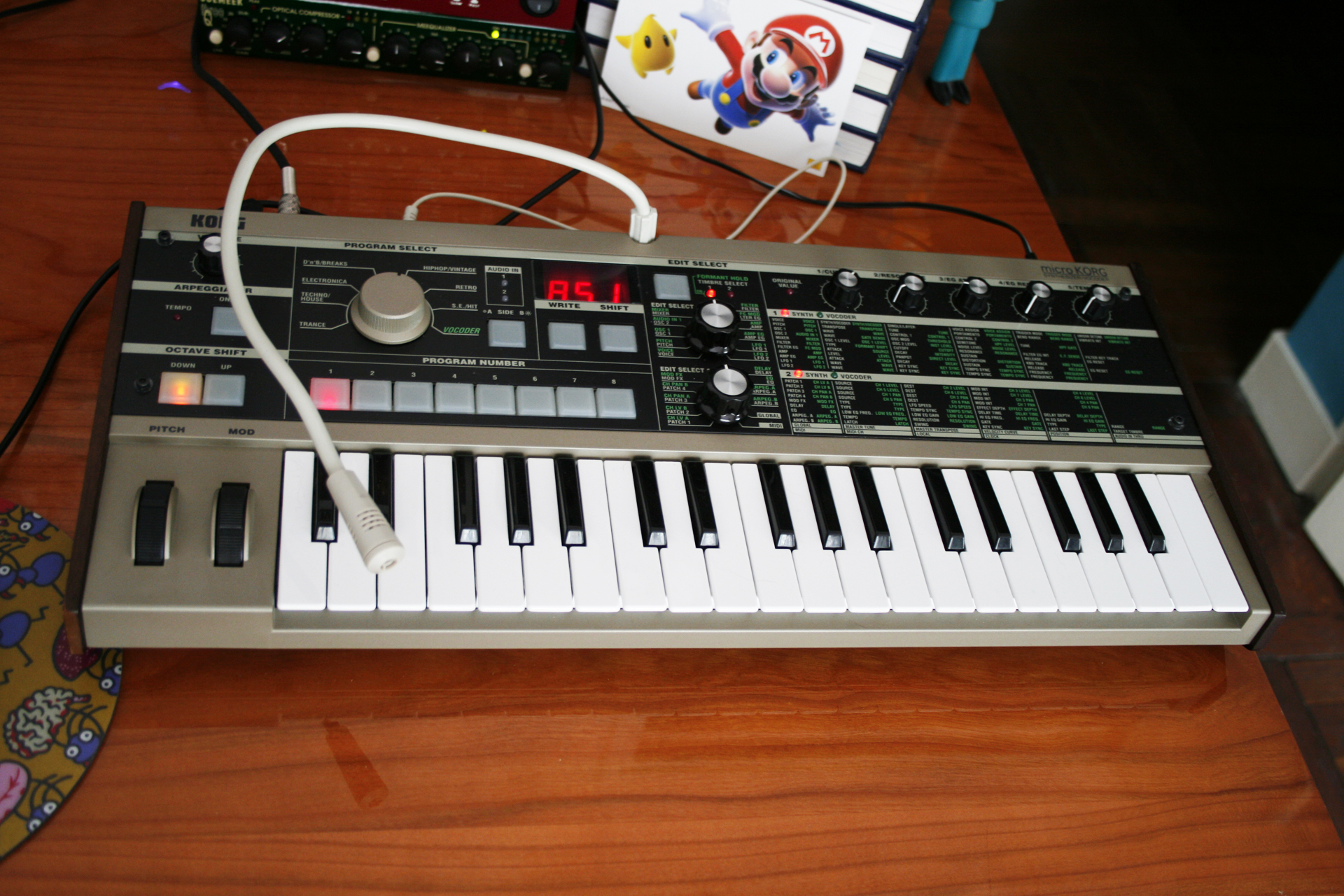
Another good soldier gone, but I wasn't using much the Juno-1 apart from the live act, and a newcomer from Korg got here this weekend (more on that tomorrow).

Again, to celebrate this fine instrument, let's repost the review.


The Alpha Juno-1 is a 1986 analogue polyphonic synthesizer from Roland.

It is actually a hybrid analogue, meaning that it features analogue oscillators with a digitally controlled tuning.
It's also a very underestimated instrument.

Browsing the web isn’t very informative. There are two comments I’ve read pretty much everywhere, one of which is debatable, the other downright wrong. First, that the Juno-1 sounds “colder” than the other Junos. Second, that the Juno-1, since it has DCOs (analog oscillators controlled digitally) rather than VCOs (the traditional voltage controlled analog oscillators), sounds “digital”.
The latter argument is irrelevant and probably uttered by persons who either have never actually played a Juno-1, or else have rotten burgers in lieu of ears. Since I can’t believe that there might be people on the internet with nothing better to do than bashing instruments they didn’t really play, I can only assume there is a rampant wave of burger infection affecting the synth-oriented population.
DCOs have received a considerable amount of scorn from analog purists all along the years. I don’t think they deserve it, because they made possible cheaper analog synths that regular musicans could actually buy, and reliable analog synths that regular musicians could actually bring on tour without having to fear night after night that the big fat analog chord that was supposed to bring the audience to their knees would come out as a pathetic yoink because of a nasty oscillator detune. Good DCOs don’t compromise sound quality as much as their detractors pretend. I actually read in a Juno-1 online review that since this Juno moved to DCOs, it sounded more digital than the VCO-based Juno-60. This, of course, is wrong, since all Junos are DCO-based. The reviewer could nonetheless tell the difference between the Juno-1’s DCOs and the Juno-60’s imaginary VCOs.


About the alleged coldness of the Juno-1, to be frank, these endless debates about “warmth” and “fatness” are somewhat tiresome to me, and trying to figure out by ear which Prophet revision sounds “warmer” is more likely to put me to sleep than a Lars Von Trier movie (I’m kidding, of course, I’ve seen “Dancer in the dark” and there’s no way you can fall asleep when assailed by such vapid nonsense).
Warmth, for one thing, is very subjective, and when discussing synths, it’s always useful to remember than our perception of analogue synthesizers as being “warm” relies on the way our ears are trained to grasp subtle nuances in audio quality. To most people, all synths pretty much sound “synth-ish”, and we all heard time and again music lovers averse to electronic instruments say that they were cold and lifeless, and I’m talking about the very same beloved analogue gear we know to be “warm” and “fat”.


All Juno track : Think of the children

Furthermore, you rarely tend to hear a synthesizer alone. A particular synth might be slightly “warmer” than another in a direct comparison, but provides the same general impression within the whole song mix. In that respect, I believe that the Juno-1 is true to the classic Roland Juno sound, and instead of “colder”, I would use words like “grittier”, “darker” or even “murkier” to describe how the Juno-1 is different from a Juno-60. I would also say that in most uses, I seriously doubt that anyone, listening to a song, could tell the difference between a Juno-1 and a Juno-60 string pad. You are, of course, free to believe otherwise. And also that the imaginary VCOs of the Juno-60 sound warmer than the DCOs of the Juno-106.
But I digress… how’s that Juno-1 anyway?

The Alpha Juno-1 is very compact, quite a small instrument with a four octaves keyboard. Very unfortunately, it isn’t velocity or pressure sensitive (unlike the bigger Alpha Juno-2), which means that although it’s not a rack, you might want sometimes to control it with a master keyboard.

Juno tweaking


The interface, let’s face it, is an abomination. All parameters, displayed on a tiny screen, are accessed by a combination of the big dial on the left, and the value button. This is, ha, I can’t even find the words to describe how unconvenient it is, so I’ll invent one, it is the one of the schprotziest synth interface I ever seen. There’s worse, but not many. Picture yourself programming a sound on the Juno-1. First you push “Parameter select”, then turn the dial clockwise to get to the parameter you want to modify, let’s say the chorus effect. Then push “Value”, then the dial again to change the value. Then “Parameter select” again, then the dial again to get to the next parameter, say the sub-osc level. Then “Value” again and the dial again to modify the value. And so on… That is tedious, dull, boring, well, total schprotz.

What you want to do for serious programming is get the PG-300 programmer along with the synth itself. The prices fly high and it’s not unusual to find the programmer at the same price than the synth. Now, I wouldn’t go as far as saying that Roland “made programming optional” (I’ve read that in an ebay bid some time ago). If you’re dedicated to creating your own sounds, I think you can cope with the schprotz, and there are some software editors to help you.
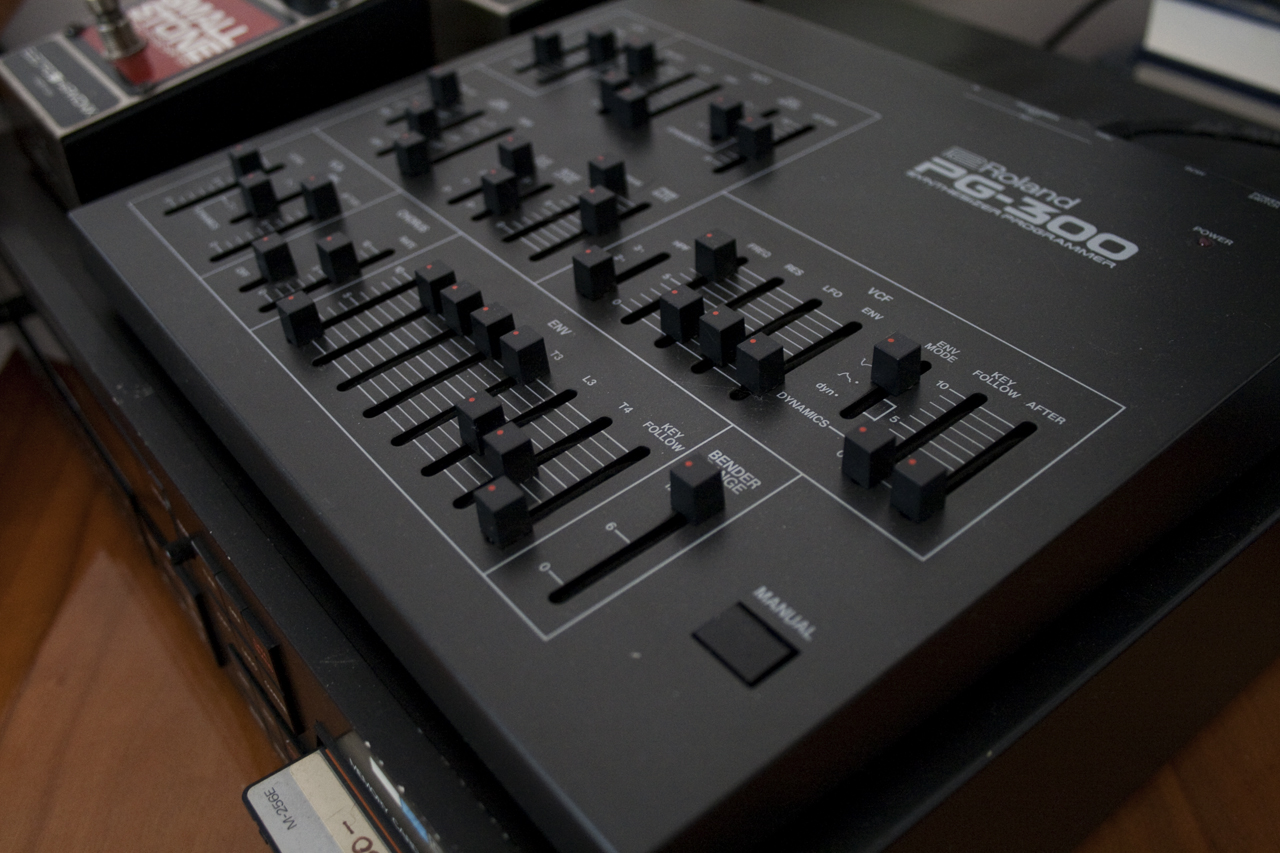
You’d be ill-advised and lazy to stick with the factory presets. But bring along the PG-300 and everything changes, because you’re back in secure analog-style interface land.


To set it up, connect the Juno-1 MIDI In to the PG-300 Out, then push the MIDI button on the Juno-1 and set the channel to 1. When it’s done, push again the button until you come to the MIDI EXCL parameter, and change it to ON. Now, the PG-300 panel allows you to control the Juno-1. Push Manual on the PG-300 to have the Juno-1 instantly follows the current knob configuration. Very easy to use, but note that there is heavy stepping on some parameters.


The combination of Juno-1 and PG-300 should probably be considered like the complete Alpha Juno synthesizer, and very often you’ll find both on sale as one package. The Juno-1 itself may be one of the cheapest analog synth on the market (I’ve got mine on ebay for 180€). Add the PG-300 and you jump to the prices of a reasonably priced Juno-106 or Juno-60, which begs the question : why would you buy an Alpha Juno instead of a Juno-60, for instance?


Let’s begin to say that it does have that special 80’s analog Roland sound. Is it a Juno-60? Well, the answer is in the question. People who criticize the Alpha Juno for not sounding exactly like the Juno-60 must be the same kind who criticize the Prophet 08 for not being a Prophet 5. Just as the Prophet 08 is a Prophet, not the Prophet 5, the Alpha Juno is one kind of Juno, with a distinctive quality shared by all Junos, but in a darker, muddier flavour.
Whether it’s a good choice depends on the kind of sounds you’re after. It’s true that the Alpha Juno lacks the visual appeal of the other Junos. It is a rather bland, unremarkable black thing. It’s also true that it lacks an arpeggiator. But sound-wise, the difference is a matter of taste. The Juno-60 sounds more “educated”, while the Alpha Juno seems to drift closer to SH-101 territory. I love that actually. There’s a special gritty quality to the Alpha Juno that eludes the other Junos, and which I find very complementary to my smoother Prophet 08.

The Juno-1 works on a single oscillator with a choice of sawtooth and pulse, but also noise and 6 sub-oscillators. This is quite sparse, so a built-in chorus is added to fatten the sound a bit. Of course, it has been suggested that Roland needed on-board chorus in order to make the synth sound good. So what? There is no such thing as “cheating” in synthesizer design. The aim is to make a good-sounding instrument, right? How you achieve that aim is irrelevant. The chorus is intregral part of the audio chain that makes the Juno sound, and arguing that they wouldn’t sound as good without the chorus is like criticizing the Minimoog for not sounding as good without its third oscillator.

It's a good chorus, but you can choose to bypass it and put your own external effect unit. On the following example, the first part is played with the on-board chorus. The second and third are played with the on-board chorus off, and the Juno-1 passing through a Electro-Harmonix Small Clone pedal at two different settings.


There’s a very useful chord memory function. Simultaneously press the chord memory and write button, then hit a chord. When you release the keys, the chord is memorized. Switch chord memory on, and each key triggers the whole chord. This is more than a fun gimmick, as it allows you to play chord blocks like you would play a mono line, with the voices being instantly reallocated to each new chord.
If instead of memorizing a chord, you memory a single note, what you get is a mono Juno…. But then try memorizing something like C1-C2-C3 and you’ve come across a nice way of creating complex mono leads.

Juno chord memory 1

Juno chord memory 2

Overall, the Juno-1 is a great instrument, with plenty of character, and in a way it’s thankfully underestimated, because that allows for a very affordable street price. I found it to be reliable, although my unit has a tendency to “forget” its first 8 user presets from time to time. The oscillators are of course very stable, but they remain analog… the Juno-1 may sometimes sound a bit odd in the first minutes, until it gets warmer. It is definitely a bargain polyphonic analog, that I would recommand any time against VSTs in the same low price bracket.

Juno chorus

Sunday, December 12, 2010

Looking Back : Machines are your Friends


Now that was a nice instrumental tune from may 2009.

I sort of tried from time to time to turn into a song, but I guess it works best as instrumental. 

Oh well, I might try again, it's  somewhat catchy.

Moog Little Phatty and Juno-1.
Drums : Electribe EMX passing through the Moog filter.

Download MP3

Tuesday, June 29, 2010

Live Rig


Rehearsing for saturday's gig...

My current setup : Roland Juno-1 and Microkorg, with Boss SP303 for fx and movie dialogue.

A whole bunch of EHX pedals (and one Marshall compressor).

Friday, December 25, 2009

Free Xmas Instrumental EP


For the holidays, this free vintage electronics instrumental EP...

The sound is totally retro and it's HERE

You can also listen to the album in streaming on archive.org.

Tracks 1 and 2 have been previously featured on this blog.
Tracks 3, 4 and 5 are remixes/revamps of oldies from the 2005 "Elevator Songs" EP.

Instruments : 90% analogue... lots of Moog Little Phatty everywhere, mostly Prophet 08 on track 1, Roland Juno-1 on track 2, and some Korg Poly-800 as well.

Saturday, December 5, 2009

Rehearsal Time


Our 19th december gig is steadily approaching, and we're ready to shine.
I'm playing here on a borrowed Airline guitar, fine, fine, retro instrument, and my Roland Juno-1.

Sunday, September 20, 2009

Chasing Ghosts Preview : Juno Time


Final synth selection from the work-in-progress "Chasing Ghosts" EP, some Roland Juno-1 multitracking extracted from the closing song.

End of Words (Roland Juno1)

Thursday, September 10, 2009

Single du Jour : Who the Fuck are You

Ahoy, hoy!
I had a very good session with singer Roxanne on tuesday for the "Chasing Ghosts" EP (remember this post) (and she's the one who also sings on the "Strawberry Blonde" album, including this song).

Now, in between projects, here's a new song that don't fit anywhere musically, so let's just say it's a single.


This is an amnesiac tune.


Moog Little Phatty, Prophet 08, Roland Juno-1, Gforce VSM and M-Tron.

UPDATE : Mmmh, I have second thoughts about it... it's a bit slower than I had envisioned at first, I just might record a second version next week! Something faster, more intense, like George would say.

Saturday, July 18, 2009

Analogue du Jour : El Condor Pasa


Some months ago, as I was working on the "Second-Hand Sequence" compilation, I first tried to tape a rendition of Paul Simon's "El Condor Pasa".
It didn't turned out quite satisfactory and I dropped the song to work on John Cale's "Captain Hook".

Last week, I thought I'd finish it anyway, adding lots of new instrumentation and choir.
Still not quite there, but I guess it's listenable!

Gear-wise, it's another all-analogue lush ballad, with Moog bass and leads, Prophet 08 and Roland Juno-1 pads.

Wednesday, July 15, 2009

The Road to 1988


I began this some months ago on the Roland Juno-1 while playing some old Amiga and Atari ST games, and feeling a bit nostalgic!

Just added some Moog bass and Prophet 08 pads and arpeggiator...

The Road to 1988

Friday, June 5, 2009

It's Analogue, Biatch


I probably shouldn't listen to Snoop Dogg before posting on this blog...

But anyway, here's an instrumental, developed from a Yamaha QY70 sketch I did in Greece last summer, and featuring a totally geekish analogue arsenal : Minikorg and Jupiter 8 (courtesy of RogerRoger, all my gratitude for his contribution), Moog Little Phatty, Roland Alpha Juno and Prophet 08...

Many thanks also to adcBicycle who provided great acoustic drums and electric bass (that thundering rumble in the middle of the track).

Undertow

Saturday, May 23, 2009

Machines are your Friends!


Join the Man-Machine Brotherhood!

Just some fun with the Moog Little Phatty and Juno-1.
Drums : Electribe EMX passing through the Moog filter.

Thursday, May 21, 2009

Showroom Dummy

Now that my setup is complete (I mean, for the time being), I think the time is ripe for a little explanatory tour.
As you can see, my studio is mostly hardware, which I tend to prefer for workflow and audio quality.
As usual, the pics links to higher resolution images.


The analogue bunch :

Moog Little Phatty : monophonic analogue, 2006 Tribute Edition, the signature Moog sound, all basses on my songs are played on this, and obviously it excels in leads. With the new arpeggiator, it's also a good source of interesting effects.


DSI Prophet 08 : polyphonic analogue (8 voices), 2007... beautiful and sophisticated sound. It's the instrument I usually use for lush, warm textures. The on-board sequencer and the ability to layer two patches are most useful to create loops and percussive grooves.


Roland Alpha Juno-1 : polyphonic analogue (6 voices), 1986... this is the one for eighties sounds with a lo-fi, dark edge. The classic Juno sound, in a punkier sort of way.


The virtual analogue connection :

Korg Microkorg : polyphonic virtual analogue (4 voices), 2002… a most successful, retro looking and sounding instrument, often derided for its toy-like appearance, but it’s a serious, surprisingly deep instrument, with great arpeggiator and a vocoder full of character.


Korg Electribe EMX-1 : polyphonic virtual analogue (16 voices), 2003… most underestimated drum machine and synth module… great sounds, great effects, and a handy 5-parts synth sequencer, allowing you to program a whole song in there.


The digital collective :

Roland D-550 w/ PG-1000 programmer : polyphonic digital (16 voices), 1987... one of the finest digital synths ever, cleverly using truncated samples to add "realism", which sounds dated today but that's what I love in it! Great strings, ethereal pads, but also a fantastic source of strange effects.


Korg Wavestation : polyphonic digital (32 voices), 1990… another fine digital instrument, of outstanding depth. The lack of a proper filter renders the sound a bit cold, but it’s the perfect tool for soundtrack or ambient work. With a little bit of programming, a single patch can provide a whole complex atmosphere.


Yamaha QY70 : portable workstation… in my bag on most vacations and weekends, a great tool to work out song ideas on the move, with very decent sounds.


And various Bontempi, Casio and Yamaha...

Friday, May 1, 2009

New free album : "Uniforms of Snow"

That's right, it's out there!

You'll also soon be able to purchase a jewel CDR version from that site.

About the album itself, check out the release info or see the post below, I'll concentrate here on the instruments, since this blog is a lot about them...

"Uniforms of Snow" was mostly composed and recorded on the Microkorg.


I actually started to record it when I first got the Microkorg, and it's all over the place... for instance, you can hear its arpegiator on the intro to "Elder Things", and the middle part of "At Last, Leaving" is also all Microkorg lead lines.

Later on, when I purchased the Moog Little Phatty, I tried to deepen the overall sound with some analogue basses and leads (for a good example, the little counterpoint thing on the second half of "Albino I").

I used the Gforce M-tron, most notably on "Elder Things" and the female choir on "Song of Ghosts".


Then I bought the Gforce Virtual String Machine plugin, and replaced some of the early freeware string machines pads with better Solina, Eminent and the lot...


The final addition was the coda to "Kadath Onward", when the theme is reprised... that's an all Roland Juno-1 arrangement.

So in the end, it's a "setup in progress" album, and I considered for a moment re-recording it with my current studio, but decided against it, as it was too much trouble and would have altered the sound too much.
It's a very Microkorgey album... the little beast from Korg is responsible for most of the little thin retro sounds, that work quite good with the more solid Moog basses and the ambient strings of the Virtual String Machine.

Monday, April 20, 2009

Mice and Men


I usually don't sample other songs, but I thought I might experiment a bit with chopping, for a change...
If you can spot the source, kudos because it's rather obscure!
Otherwise, that track is all Roland Alpha Juno, which is the perfect instrument for darker, muddy, analogue textures.

Sunday, April 19, 2009

The Synth is Japanese


And so is the tune...
This time it's an original, and an alternate version of a song featured in my upcoming "Strawberry Blonde" album
Roland Juno-1 for the pads...

Origami no uta

Sunday, March 29, 2009

Roland Inside : Jarre meets Art of Noise

Nothing serious at all here!
Just some silly fun with the Rolands D-550 and Juno...

And a music quizz : tell me which three instrumental tracks from the 80s are referenced here.

The correct answer wins a Moog Voyager (if I can get Moog Music interested in this fascinating challenge, otherwise you'll get all my consideration).

1889

Saturday, March 14, 2009

Bob Dylan goes Analogue


Well, not really, but I happen to be a huge Dylan fan, and among the many gems on his last Bootleg Series CD, this one particular song I really loved...


Moog bass, Prophet 08 pad and lead, guitar on the left channel, Roland Juno-1 on the right...

Tuesday, March 3, 2009

Analogue Sounds


They're good.
A little demo : Moog bass, Juno-1, Prophet 08 and... Roland D550 strings...

Tuesday, February 24, 2009

Roland Alpha Juno-1 and PG-300


First, a reminder... my new analogue pop free EP is out and if you haven't got it, well, you should because it's a good one, so browse that page down and come back!

Now to business...

The Alpha Juno-1 is a 1986 analogue polyphonic synthesizer from Roland.

It is actually a hybrid analogue, meaning that it features analogue oscillators with a digitally controlled tuning.
It's also a very underestimated instrument.

Browsing the web isn’t very informative. There are two comments I’ve read pretty much everywhere, one of which is debatable, the other downright wrong. First, that the Juno-1 sounds “colder” than the other Junos. Second, that the Juno-1, since it has DCOs (analog oscillators controlled digitally) rather than VCOs (the traditional voltage controlled analog oscillators), sounds “digital”.
The latter argument is irrelevant and probably uttered by persons who either have never actually played a Juno-1, or else have rotten burgers in lieu of ears. Since I can’t believe that there might be people on the internet with nothing better to do than bashing instruments they didn’t really play, I can only assume there is a rampant wave of burger infection affecting the synth-oriented population.
DCOs have received a considerable amount of scorn from analog purists all along the years. I don’t think they deserve it, because they made possible cheaper analog synths that regular musicans could actually buy, and reliable analog synths that regular musicians could actually bring on tour without having to fear night after night that the big fat analog chord that was supposed to bring the audience to their knees would come out as a pathetic yoink because of a nasty oscillator detune. Good DCOs don’t compromise sound quality as much as their detractors pretend. I actually read in a Juno-1 online review that since this Juno moved to DCOs, it sounded more digital than the VCO-based Juno-60. This, of course, is wrong, since all Junos are DCO-based. The reviewer could nonetheless tell the difference between the Juno-1’s DCOs and the Juno-60’s imaginary VCOs.


About the alleged coldness of the Juno-1, to be frank, these endless debates about “warmth” and “fatness” are somewhat tiresome to me, and trying to figure out by ear which Prophet revision sounds “warmer” is more likely to put me to sleep than a Lars Von Trier movie (I’m kidding, of course, I’ve seen “Dancer in the dark” and there’s no way you can fall asleep when assailed by such vapid nonsense).
Warmth, for one thing, is very subjective, and when discussing synths, it’s always useful to remember than our perception of analogue synthesizers as being “warm” relies on the way our ears are trained to grasp subtle nuances in audio quality. To most people, all synths pretty much sound “synth-ish”, and we all heard time and again music lovers averse to electronic instruments say that they were cold and lifeless, and I’m talking about the very same beloved analogue gear we know to be “warm” and “fat”.


Furthermore, you rarely tend to hear a synthesizer alone. A particular synth might be slightly “warmer” than another in a direct comparison, but provides the same general impression within the whole song mix. In that respect, I believe that the Juno-1 is true to the classic Roland Juno sound, and instead of “colder”, I would use words like “grittier”, “darker” or even “murkier” to describe how the Juno-1 is different from a Juno-60. I would also say that in most uses, I seriously doubt that anyone, listening to a song, could tell the difference between a Juno-1 and a Juno-60 string pad. You are, of course, free to believe otherwise. And also that the imaginary VCOs of the Juno-60 sound warmer than the DCOs of the Juno-106.
But I digress… how’s that Juno-1 anyway?

The Alpha Juno-1 is very compact, quite a small instrument with a four octaves keyboard. Very unfortunately, it isn’t velocity or pressure sensitive (unlike the bigger Alpha Juno-2), which means that although it’s not a rack, you might want sometimes to control it with a master keyboard.


The interface, let’s face it, is an abomination. All parameters, displayed on a tiny screen, are accessed by a combination of the big dial on the left, and the value button. This is, ha, I can’t even find the words to describe how unconvenient it is, so I’ll invent one, it is the one of the schprotziest synth interface I ever seen. There’s worse, but not many. Picture yourself programming a sound on the Juno-1. First you push “Parameter select”, then turn the dial clockwise to get to the parameter you want to modify, let’s say the chorus effect. Then push “Value”, then the dial again to change the value. Then “Parameter select” again, then the dial again to get to the next parameter, say the sub-osc level. Then “Value” again and the dial again to modify the value. And so on… That is tedious, dull, boring, well, total schprotz.

Juno tweaking


What you want to do for serious programming is get the PG-300 programmer along with the synth itself. The prices fly high and it’s not unusual to find the programmer at the same price than the synth. Now, I wouldn’t go as far as saying that Roland “made programming optional” (I’ve read that in an ebay bid some time ago). If you’re dedicated to creating your own sounds, I think you can cope with the schprotz, and there are some software editors to help you.

You’d be ill-advised and lazy to stick with the factory presets. But bring along the PG-300 and everything changes, because you’re back in secure analog-style interface land.


To set it up, connect the Juno-1 MIDI In to the PG-300 Out, then push the MIDI button on the Juno-1 and set the channel to 1. When it’s done, push again the button until you come to the MIDI EXCL parameter, and change it to ON. Now, the PG-300 panel allows you to control the Juno-1. Push Manual on the PG-300 to have the Juno-1 instantly follows the current knob configuration. Very easy to use, but note that there is heavy stepping on some parameters.


The combination of Juno-1 and PG-300 should probably be considered like the complete Alpha Juno synthesizer, and very often you’ll find both on sale as one package. The Juno-1 itself may be one of the cheapest analog synth on the market (I’ve got mine on ebay for 180€). Add the PG-300 and you jump to the prices of a reasonably priced Juno-106 or Juno-60, which begs the question : why would you buy an Alpha Juno instead of a Juno-60, for instance?


Let’s begin to say that it does have that special 80’s analog Roland sound. Is it a Juno-60? Well, the answer is in the question. People who criticize the Alpha Juno for not sounding exactly like the Juno-60 must be the same kind who criticize the Prophet 08 for not being a Prophet 5. Just as the Prophet 08 is a Prophet, not the Prophet 5, the Alpha Juno is one kind of Juno, with a distinctive quality shared by all Junos, but in a darker, muddier flavour.
Whether it’s a good choice depends on the kind of sounds you’re after. It’s true that the Alpha Juno lacks the visual appeal of the other Junos. It is a rather bland, unremarkable black thing. It’s also true that it lacks an arpeggiator. But sound-wise, the difference is a matter of taste. The Juno-60 sounds more “educated”, while the Alpha Juno seems to drift closer to SH-101 territory. I love that actually. There’s a special gritty quality to the Alpha Juno that eludes the other Junos, and which I find very complementary to my smoother Prophet 08.

The Juno-1 works on a single oscillator with a choice of sawtooth and pulse, but also noise and 6 sub-oscillators. This is quite sparse, so a built-in chorus is added to fatten the sound a bit. Of course, it has been suggested that Roland needed on-board chorus in order to make the synth sound good. So what? There is no such thing as “cheating” in synthesizer design. The aim is to make a good-sounding instrument, right? How you achieve that aim is irrelevant. The chorus is intregral part of the audio chain that makes the Juno sound, and arguing that they wouldn’t sound as good without the chorus is like criticizing the Minimoog for not sounding as good without its third oscillator.

It's a good chorus, but you can choose to bypass it and put your own external effect unit. On the following example, the first part is played with the on-board chorus. The second and third are played with the on-board chorus off, and the Juno-1 passing through a Electro-Harmonix Small Clone pedal at two different settings.

Juno chorus


There’s a very useful chord memory function. Simultaneously press the chord memory and write button, then hit a chord. When you release the keys, the chord is memorized. Switch chord memory on, and each key triggers the whole chord. This is more than a fun gimmick, as it allows you to play chord blocks like you would play a mono line, with the voices being instantly reallocated to each new chord.
If instead of memorizing a chord, you memory a single note, what you get is a mono Juno…. But then try memorizing something like C1-C2-C3 and you’ve come across a nice way of creating complex mono leads.

Juno chord memory 1

Juno chord memory 2

Overall, the Juno-1 is a great instrument, with plenty of character, and in a way it’s thankfully underestimated, because that allows for a very affordable street price. I found it to be reliable, although my unit has a tendency to “forget” its first 8 user presets from time to time. The oscillators are of course very stable, but they remain analog… the Juno-1 may sometimes sound a bit odd in the first minutes, until it gets warmer. It is definitely a bargain polyphonic analog, that I would recommand any time against VSTs in the same low price bracket.

Tuesday, February 10, 2009

New free EP : Broken Sails

The new EP is here!


It's called "Broken Sails (Life in a Sinking Ship)" and the whole zip with complete CD artwork is HERE
If you liked it, be sure to give me feedback here or by email to khoralnet[nospam]free.fr


Thematically, "Broken Sails" is about XIXth sea travel... not really a concept album, but it's subtitled "Life in a sinking ship" because that's pretty much what the songs are all about... a dark, intense trip to India, set on a broken ship...

I took inspiration from John Cale's song "Captain Hook", the epic but introspective tale I covered some time ago for a compilation, and of course, the Conrad novel which lends its name to the opening track.
Musically, we're in lush analogue pop territory, with rich, warm textures and vintage drum machines.
Looking back, the sound is evocative of Dennis Wilson's incredible "Pacific Ocean Blues" album, with its dense, intricate wall of sound, but also Devo's synth-pop ("Heart of Darkness"), Dylan and REM's folk classicism ("Broken Sails") and Peter Gabriel's organic soundscapes ("The Ghost of India Supreme", which borrows its name from "Captain Hook" lyrics).

It was essentially done with the Prophet 08 as main instrument... if you listen to tracks 1 or 4, for instance, that's pretty much the fantastic synth from Dave Smith Instruments all the way through...
Save for that... well, whenever you hear bass, that's the Moog Little Phatty...
The strings on "The Fortune Song" are Gforce Virtual String Machine and there's some Roland Alpha Juno-1 as well on the instrumental parts for this track.
The opening chords on "Empty the Boat" are Korg Wavestation.