Showing posts with label electro harmonix. Show all posts

Wednesday, February 4, 2015

Passions Amplifiées - Folle Journée 2015

Our series of concerts during the classical festival Folle Journée in Nantes is over...
It's been quite a ride... 6 performances of "Boundless River", a song created out of Erik Satie's "Gymnopédie n°1", "Gnossiennes n°1" and Philip Glass's "Dead Things", with lyrics from Emily Dickinson's poems. Good crowd, especially the Cité des Congrès concert at the Hegel hall, which attracted 700 people.

Gear-wise, I've been using a pedalboard with EHX Electric Mistress, Big Muff Pi and Strymon Timeline, my DSI Tempest for drums and sequences, and a Novation Bass Station II.


Sunday, November 23, 2014

Sound Test : MS20 Mini + EHX Iron Lung

Bonus from my Ghostbusters video.
The vocoder sound is using the MS20 Mini with Electro Harmonix Iron Lung pedal.


Tuesday, March 5, 2013

CasioStone

Experimenting these days with various instrumental ditties for a video project.
Here, passing the Casiotone through the Small Stone phaser.
Old school.


Thursday, May 5, 2011

New Pedal : EHX Freeze

It's been a long time since I haven't bought an Electro-Harmonix pedal, eh?
Here's the Freeze.
It literally freezes whatever you play the instant you press the switch, which is why EHX calls it "infinite sustain".
Really good for creating textures and guitar pads. I'll be sure to post some sounds this weekend to show this off.
Meanwhile, check out these videos :
http://www.ehx.com/products/freeze
http://www.youtube.com/watch?v=iOabP5WZLMY

Friday, December 24, 2010

The Soundtrack Life : Recording “Voight Kampff” part1

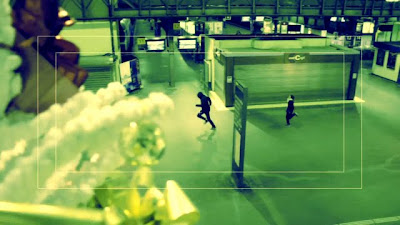
So, I'm working on the soundtrack to a thriller/scifi short film by Thomas Lesourd.


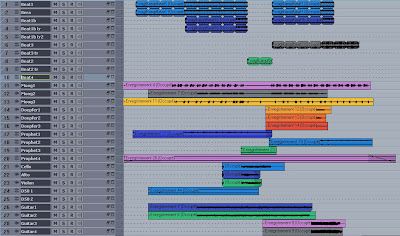
Here's a little tutorial on the making of the main action cue, "Voight Kampff".


This particular track was actually recorded before I was able to see any footage of the short film. Hell, none had even been shot at the time! I was told by the filmmaker that the film would need some fast-paced, street chasing music.

I decided to go for a tight, urban sound, built around a fat and biting Moog groove.The tempo is relatively slow, because I was expecting to create a sort of musical momentum, beginning with an almost hiphop-styled groove, Mellotron strings, a quiet break, then full-on electric and industrial madness, with nasty guitars and crazy electronic bleeps.

Whether it’s a song or an instrumental, and unless I’m 100% sure that there won’t be any beat and that the track won’t need any fixed tempo, my first step is always to program one, at the very least to provide a tempo guide for recording.

Method-wise, there’s a big difference between recording a song and an instrumental. I will almost always start the former with a completed song. On the other hand, building up the latter is pure improvisation, in that I simply have no idea what the track will be until I push Record and improvise something that I’ll then expand upon.

So, I’ve started by programming a first beat, with the Drums Overkill plugin as main source. This is an excellent database, using the Kontakt engine. Not only does it feature almost every vintage drum machine ever built, but also a clever sample collection arranged in sections such as “hiphop”, “drum and bass”, “experimental”. All in all, a very useful source that provides a large variety of drum sounds that you can tweak within Kontakt.


This particular beat also features a couple of “natural” sounds, that is, a gunshot and a falling bullet shell, both from a huge database of movie sounds I have assembled over the years. Mixing-wise, I’ve juxtaposed two layers of the same beat. The first one has a 6dB boost at 64Hz.

The second one is squashed to death by a compressor, then radically EQd to cut most bass and high frequencies, and boost the mids (EQ deep cut below 150Hz and at 16Khz, boost between 1Khz and 10Khz). This is pretty much a variation on what it’s called parallel compression of New York compression : http://en.wikipedia.org/wiki/Parallel_compression.
I then programmed a second beat, which comes midway to reinforce the rhythmic section. This one was treated in pretty much the same way.


Voight Beat (MP3) 

Now that a basic rhythmic foundation is in place, my second task is to lay down some instrumental part that will define what the chord progression (if any) will be, and what the overall tune will be. I would usually play piano or possibly some synth pad, but for this particular track, since it’s meant to be very rhythmic, I’ve chosen to sketch out a bass groove.

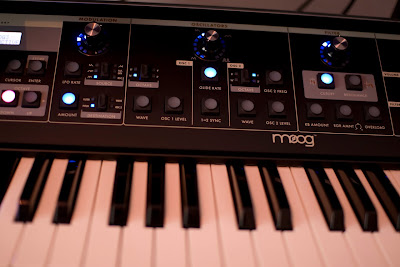
Gear-wise, bass to me means MOOG!


A little bit of experimentation here as well : the Moog Little Phatty is plugged to the UA 710 preamp, with a blend of 50-50 solid-state and tube signal, and a fair amount of gain to make it distort. That little trick provides a bit of additional grit to the bass sound. There are 3 Moog layers involved here.


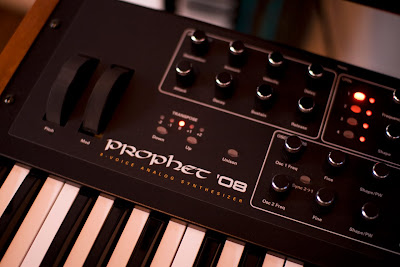
I then proceeded to add some more harmonic parts around that beat/bass core.The Prophet 08 was to put to use there.

Voight Prophet (MP3) 


Now the track was coming together but it still needed a fuller sound. A couple of electric guitars, playing the fundamental note over and over, would fit it nicely.
It’s often a good idea to record the exact same guitar part twice, and pan one on the extreme left and the other on the extreme right. That’s what I did, and I should add that the slightly off-key, grungey guitar sound was obtained in two way : tuning the first string one step down and passing it through a Small Clone chorus.

Some EQ there too : light boost at 1Khz, cut at 10Khz and big cut 16Khz.


Voight Guitar (MP3) 

Finally, I knew at this point that there’d be a quieter, breathing space in the middle before the electric onslaught, so I thought about adding little pseudo-orchestral transition, to get a little harmonic build-up before the break.


There’s a lot of orchestral software out there, but I do prefer to create little weird, retro chamber orchestras using Gforce’s M-Tron, and now M-Tron Pro, plugins.


The Mellotron of course is very limited, which fits my idea totally. A little arrangement of Mellotron cellos, violas and violins gives a vintage, off-beat strings flavor which has far more character than any realistic emulation of orchestra would give.


Monday, October 11, 2010

More Electro-Harmonix Playing


If you're interested in Electro-Harmonix guitar pedals, here's some audio clips : Download MP3

First, dry guitar sound (Vintage V100 Les Paul), then : 

0.16 : Small Clone (chorus)

1.16 : Stereo Pulsar (tremolo)

2.07 : Stereo Electric Mistress (flanger/chorus)

3.00 : Memory Boy (delay)

3.50 : Big Muff (fuzz)

5.10 : Several of 'em 

Sunday, September 19, 2010

Test Mode : Big Muff + Mini Q-Tron


Here's some riffs trying out a combination of badass Electro Harmonix pedals.

Download MP3

The oh-so-famous Big Muff Pi (fuzz) and the aforementioned Mini Q-Tron (envelop filter).

Vintage V100 guitar with clean sound at the beginning.

The Big Muff kicks in at 0.05.

The Mini Q-Tron is added at 0.20.

Then I'm switching between Big Muff alone and Big Muff/Q-Tron.

All in all, an outstanding pairing for some fuzzy, warm, nasty tones.

Saturday, September 18, 2010

Introducing the Mini Q-Tron


Here's a nice envelop filter pedal I bought yesterday for a ridiculously low price.

It has three different filters, Low Pass, Band Pass and High Pass, modulated with one Drive knob (controlling the width of the filter’s sweep range) and one Q knob (controlling the frequency peak of the filter).

Using the different filter modes, the sound can be beefy and rich, with a warm sweeping texture, or thin and bright, for a funkier tone that cuts through the mix.

I'll post some samples later on, but let's just say now that it's one excellent pedal (well, aren't all EHX pedals?)

Thursday, September 9, 2010

Big Muff Mania


I'm a huge fan of Electro Harmonix guitar effects, and the classic Big Muff fuzz box is surely one of my favorite for its creamy, grungey, warm tone.

Now here's a most excellent site with a complete history of this great pedal.

Tuesday, June 29, 2010

Live Rig


Rehearsing for saturday's gig...

My current setup : Roland Juno-1 and Microkorg, with Boss SP303 for fx and movie dialogue.

A whole bunch of EHX pedals (and one Marshall compressor).

Saturday, May 29, 2010

Attack of the Bee Woman


Experimenting a bit with analog pedals...

The Moog Little Phatty is passing through EHX Memory Boy delay, providing various insect lead sounds.

The Korg Poly-800 is plugged to EHX Electric Mistress flanger.


Attack of the Bee Woman by khoral

Sunday, March 7, 2010

Electro-Harmonix Round-Up : 6 Reviews


So, I'm sort of an EHX buff, as you can probably tell.
Not that I own any stock, but their line-up is outstanding in quality and covering a wide price range.

I figured it was time for a complete review of my little collection.

First, some samples:

Small Clone (analog chorus)
A classic chorus : 1 Depth switch, 1 Rate knob, plug in a good guitar, play some major mode arpeggios and you’re back in 1990.
Like most vintage-style EHX pedals, it sure ain’t the most versatile tool, but that’s not the point. This is a straightforward, top quality, vintage analog chorus, aimed to provide instant gratification. It’s deep, musical, warm, giving depth and warmth to any sound at light settings and produces beautiful bubbley leads at heavy settings.


Memory Boy (analog delay)
This is a very fine offering from EHX to anyone looking for a reasonably priced analog delay. It’s much cheaper than the outstanding Deluxe Memory Man, but still features an interesting amount of functions.
1 Delay knob, with a 30ms to 550ms time range. That’s short compared to a digital delay, but then again, if you bought the Memory Boy, what you’re after is that special analog delay sound, the imperfect, muffled, warm echoes of an analog delay.
1 Depth knob, adding modulation to the signal, using either a triangle or a square waveform… for a regular delay effect, you’ll have this turned all the way left, but as you turn it clockwise, your guitar sound will get weirder and weirder till you happily destroy the signal. The rate of modulation is adjustable as well, from slow to medium to fast.
1 Blend knob, to mix the dry and wet signals, and finally the classic Feedback knob.
Overall, a most interesting buy, and probably a better choice than the even cheaper Memory Toy.

Big Muff (fuzz)
Now, here’s the real deal! Is there anything left to say on this mythical piece?
1 Volume knob, 1 Tone knob (from muffled, dark and warm to bright, edgy and mean), 1 Sustain knob (I guess Nigel Tufnel still is in the bathroom).
I unfortunately didn’t have much chance to record it for practical reasons, but I’ve been playing that one live on my jazzy Emperor Joe Pass hollowbody guitar and a Fender amp, and it’s pretty much the best electric guitar sound I have ever heard : deep, powerful, warm, a screaming yet mostly musical, organic, wall of sound.


Small Stone (analog phaser)
The Small Stone is a revered phase shifter pedal from Electro Harmonix, with a most distinguished pedigree, harking back to the glory days of EMS, the groundbreaking british company responsible for such electronic marvels as the VCS3. Engineer David Cockerell, first hired by EMS to work on early computer systems for music, designed in 1971 a very peculiar (and pricey according to long time user David Gilmour) guitar effect called the Synthi Hi-Fli, featuring advanced phase shifting and vibrato functions, along with that special EMS retro-futuristic look. Engaged by Electro Harmonix, Cockerell went on to create some of the best guitar effects, including the Small Stone phaser.
Very simple unit : 1 Rate knob, 1 Color switch, adding feedback to the 4 stage phasing effect. While it is mainly a guitar effect, nothing prevents you from plugging another audio source, which is precisely what French synthesist JM Jarre did, using the first 1974 version of the pedal (along with the Electric Mistress pedal, another Electro Harmonix product) on his Eminent 310U to create the astounding atmospheric pads of Oxygène (1976) and Equinoxe (1978).
My own Small Stone is the third version from 1980.


Stereo Pulsar (stereo tremolo)
While the tube-powered Wiggler is possibly the best EHX tremolo, it’s still quite expensive, and when looking for a vintage-sounding tremolo, you might want to opt for the Stereo Pulsar.
On its face, tremolo isn’t the fanciest effect, but it’s an important one nonetheless, whether you want to add depth and body to the guitar sound (light settings), create a retro fluttering lead (medium settings) or that familiar stagger that works so well with distortion (heavy settings).
What you’ve got here is:
1 Depth knob, controlling how deep the volume modulation will be.
1 Shape knob and 1 switch to select between triangle and sawtooth modulation waveforms and alter the shape of this waveform from pulse width to square.
1 Rate knob to control the modulation speed.


Electric Mistress (stereo flanger and chorus)
Here’s another recreation of a very classic 70’s pedal (which Jarre also used on synths).
It’s basically a flanger, with 1 Rate knob for speed and a couple of Depth knobs, but EHX have added a chorus to the mix, which allows for a wider array of shimmering, liquid textures.
Oh, and it’s stereo, which doesn’t hurt.

Sunday, November 22, 2009

Electro Harmonix Memory Boy (first thoughts)


I'm a huge fan of EHX's analog pedals.
First, I bought a 1980 Small Stone phaser, then a new Small Clone chorus.
My next move was supposed to be the outstanding Deluxe Memory Man analog delay, but it's a bit too pricey for my taste.
So when EHX released cheaper, cut-down versions, namely the Memory Toy and Memory Boy, I couldn't resist anymore.

I'll probably do a little review at some point, but I can already post some experiments I did yesterday.
These are extracted from a new song I'm currently recording. They combine all three pedals.


Monday, January 19, 2009

Small Stoned Prophet

The Small Stone is a revered phase shifter pedal from Electro Harmonix, with a most distinguished pedigree, harking back to the glory days of EMS, the groundbreaking british company responsible for such electronic marvels as the VCS3.

Engineer David Cockerell, first hired by EMS to work on early computer systems for music, designed in 1971 a very peculiar (and pricey according to long time user David Gilmour) guitar effect called the Synthi Hi-Fli, featuring advanced phase shifting and vibrato functions, along with that special EMS retro-futuristic look.


Engaged by Electro Harmonix, Cockerell went on to create some of the best guitar effects, including the Small Stone phaser. It is a very straightforward unit, with a rate knob and a colour switch, adding feedback to the 4 stage phasing effect. There has been a number of versions all through the years (some produced in Russia, the Sovtek series), sharing the same basic architecture, with slight differences in tone. Today’s commercial units are the fourth (classic) and fifth (nano) version.


While it is mainly a guitar effect, nothing prevents you from plugging another audio source, which is precisely what French synthesist JM Jarre did, using the first 1974 version of the pedal (seen above, photo from P.A.S.) on his Eminent 310U to create the astounding atmospheric pads of Oxygène (1976) and Equinoxe (1978).


My own Small Stone is the third version from 1980.
The following examples are done with the Prophet 08 only, processed by the Small Stone.

Two Pads

One Pad

The Prophet beat from the previous post, phased to death