Showing posts with label yamaha QY70. Show all posts

Wednesday, September 9, 2009

Yamaha QY70

It's been a while, so here's a little review...

When Yamaha released its first QY product, back in 1990, I thought it was the coolest thing in the whole wide world : a hand-held music workstation that you could carry everywhere to make music. It might seem trivial in this age of music applications for Nintendo DS and iPhone, but back then, boy did it seem awesome, especially since it was a luxury the teen I was couldn’t afford. The sounds were crude, and the interface quite limited, but you wouldn’t really buy a QY10 to produce a professional piece of music or even to control more advanced instruments. The QY10 was meant to be an electronic sketchpad. A self-contained, easy-to-use station that you would take on the train or anywhere in order to write music, which you would later on record properly with “real” instruments.

The QY70 is the 1997 incarnation of the concept. Again, you won’t use it to make a proper, final song (I’ve seen at least one band on the web use it as their main production tool, but that’s pointless gimmickry). At heart, the QY70 is a compositional tool, whether you want a small, battery-powered device to work out song ideas on the road, or just change your method of writing.

It’s broadly the size of a VCR tape, a bit heavy with the 6 batteries, but still very convenient to carry around.


The little thing can store 20 songs with 16 tracks each. The onboard sounds are pretty good. Of course, the acoustic sounds (XG format) won’t fool anyone, and the synthetic ones don’t exactly match those of a Moog, but that’s beside the point. The point, I can’t stress this enough, is to work out the blueprints for a song. The QY70 sounds a bit sterile and MIDI, but it’s all inspiring enough, and mind you, there’s even a nice little analogue-style editing mode (ADSR/Cut-off/Resonance) to make things a bit more personal.

The Farewell Song II (QY70 demo)

You can program step-by-step, but might find it difficult on this little LCD screen, compared to computer work. I myself would rather perform all the parts live on the tiny tiny buttons, track after track. Tricky to hit the notes right, but more satisfying in the end, if like me you dislike sequencing zillion of notes.

Aegian (QY70 demo)

The QY70 also comes with pre-programmed automatic arrangements, like you may find on a home keyboard. While I don’t find them as inspiring as building tunes from scratch, they’re surprisingly good, cover all major styles and there’s even some basic chord progressions to choose from and improvise melodies on.

Seasong (QY70 demo, using the onboard arrangements)

All in all, the QY series might still be a kind of luxury, but a good buy if you like fun miniature workstations to bring on the beach or in the mountains and write some tunes.

Friday, June 5, 2009

It's Analogue, Biatch


I probably shouldn't listen to Snoop Dogg before posting on this blog...

But anyway, here's an instrumental, developed from a Yamaha QY70 sketch I did in Greece last summer, and featuring a totally geekish analogue arsenal : Minikorg and Jupiter 8 (courtesy of RogerRoger, all my gratitude for his contribution), Moog Little Phatty, Roland Alpha Juno and Prophet 08...

Many thanks also to adcBicycle who provided great acoustic drums and electric bass (that thundering rumble in the middle of the track).

Undertow

Thursday, May 21, 2009

Showroom Dummy

Now that my setup is complete (I mean, for the time being), I think the time is ripe for a little explanatory tour.
As you can see, my studio is mostly hardware, which I tend to prefer for workflow and audio quality.
As usual, the pics links to higher resolution images.


The analogue bunch :

Moog Little Phatty : monophonic analogue, 2006 Tribute Edition, the signature Moog sound, all basses on my songs are played on this, and obviously it excels in leads. With the new arpeggiator, it's also a good source of interesting effects.


DSI Prophet 08 : polyphonic analogue (8 voices), 2007... beautiful and sophisticated sound. It's the instrument I usually use for lush, warm textures. The on-board sequencer and the ability to layer two patches are most useful to create loops and percussive grooves.


Roland Alpha Juno-1 : polyphonic analogue (6 voices), 1986... this is the one for eighties sounds with a lo-fi, dark edge. The classic Juno sound, in a punkier sort of way.


The virtual analogue connection :

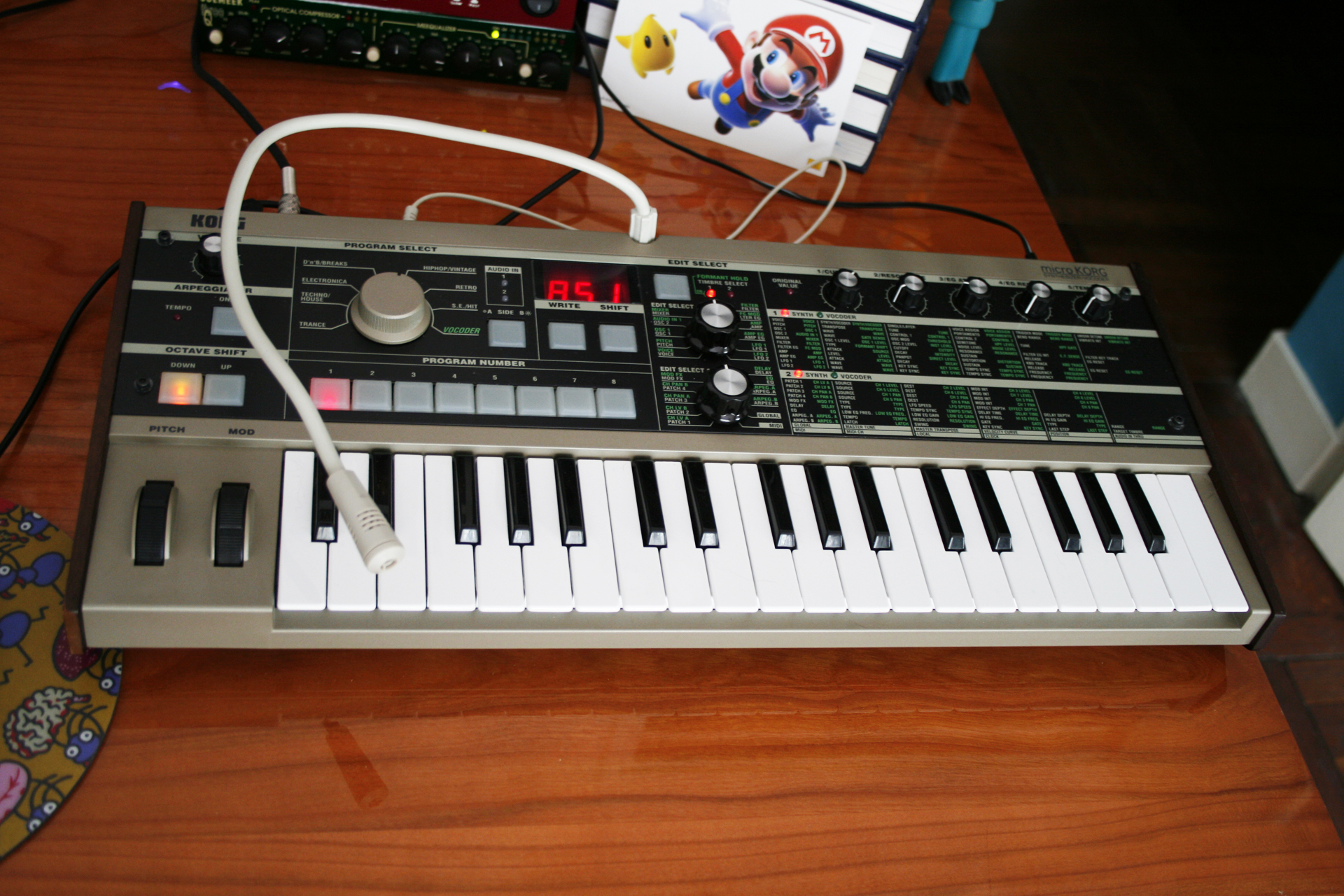
Korg Microkorg : polyphonic virtual analogue (4 voices), 2002… a most successful, retro looking and sounding instrument, often derided for its toy-like appearance, but it’s a serious, surprisingly deep instrument, with great arpeggiator and a vocoder full of character.


Korg Electribe EMX-1 : polyphonic virtual analogue (16 voices), 2003… most underestimated drum machine and synth module… great sounds, great effects, and a handy 5-parts synth sequencer, allowing you to program a whole song in there.


The digital collective :

Roland D-550 w/ PG-1000 programmer : polyphonic digital (16 voices), 1987... one of the finest digital synths ever, cleverly using truncated samples to add "realism", which sounds dated today but that's what I love in it! Great strings, ethereal pads, but also a fantastic source of strange effects.


Korg Wavestation : polyphonic digital (32 voices), 1990… another fine digital instrument, of outstanding depth. The lack of a proper filter renders the sound a bit cold, but it’s the perfect tool for soundtrack or ambient work. With a little bit of programming, a single patch can provide a whole complex atmosphere.


Yamaha QY70 : portable workstation… in my bag on most vacations and weekends, a great tool to work out song ideas on the move, with very decent sounds.


And various Bontempi, Casio and Yamaha...