From an old recording of a demented neighbor.
Korg Wavestation, Doepfer Dark Energy, Korg Monotron.

Showing posts with label Korg Wavestation. Show all posts
Showing posts with label Korg Wavestation. Show all posts
Sunday, February 10, 2013

Sunday, November 27, 2011
Work in Progress : "All the Drugs" (session 1)
Recording sessions for a new song.
No playback, all shots show the actual takes being recorded.
I'll update the video as the recording and mixing goes along.
Untitled from Karim More on Vimeo.
Friday, September 24, 2010
Programming Wavesequences on the Wavestation

The Wavesequencing system is possibly the very best feature of the Korg Wavestation and yet is also the most overlooked by players, since programming wavesequences can be somewhat intimidating.
Here’s a simple step-by-step tutorial on how to program wavesequences.
In EDIT PERFORMANCE, choose a Patch.
In EDIT PATCH, press Init to reset the Patch.
Choose an oscillator, then press WAVES to choose the waveform.
On the ROM, waveforms 0 to 31 are wavesequences you can use for a Patch, but not modify.
On the RAM1 and RAM2, you’ll only find wavesequences, which you can alter. When you’re selecting a wavesequence, the WAVESEQ function should appear on the bottom right of the screen.
Please note that alterations to these wavesequences is instantly written to RAM, there’s no need to save and you’d better back up a wavesequence on another slot beforehand.
Press WAVESEQ to enter programming mode for the wavesquence.
If there are already steps in the wavesequence, just press DELETE to get start from scratch.
Then INSERT to add new steps.
By default, the result on the screen should be something like :
2 ROM 32 Soft EP 0 0 99 24 24
3 ROM 32 Soft EP 0 0 99 24 24
4 ROM 32 Soft EP 0 0 99 24 24
As you can see, each step is a waveform.
First thing you should do is set up different waveforms for each step.
For instance:
1 ROM 32 Soft EP 0 0 99 24 24
2 ROM 41 Organ 1 0 0 99 24 24
3 ROM 53 MuteGtr1 0 0 99 24 24
4 ROM 32 Sybass1 0 0 99 24 24
A bit of explanation for the values here :
The second 0 (Fine) allows for fine pitch tuning.
The 99 (Lev) changes the volume of the waveform.
The 24 (Dur) represents the length of each step (1 to 499... small values produce very rhythmic sequences, big values allow for more evolving sounds)
The last 24 (Xfd) impacts the transition between step, that is the cross-fading (0 will produce little clicks between steps, the transition becoming smoother as you raise the value)
Finally on the bottom of the screen :
Loop Dir indicates the way steps are played : FOR means Forward, B/F means Back&Forth
Repts indicates the number of times the whole wavesequence is repeated (by default, INF for Infinite).
That’s the basics of the system.
You should now be able to create your own wavesequences. Have fun!
Saturday, August 28, 2010
The European Son

Another track from the instrumental "Upon a Sleepless River" album, available as free download on Bitkins label.
This was mostly done with Korg Wavestation, Moog Little Phatty and Prophet 08.
The European Son by khoral
Friday, August 13, 2010
The Soundtrack Life
Another ambient study for sci-fi film project "PEG".
Korg Wavestation and Prophet 08 (and some Gforce VSM at the end).
Monday, July 26, 2010
A la THX


This is a mood study for film project "PEG" mentioned yesterday. It's a sketch in the style of THX 1138, to get a better idea of what could be done.
This particular experiment is somewhat too generic. I have to figure out for the real soundtrack what more exotic elements to add, while still retaining that ambient, atmospheric feel.
I used the Korg Wavestation, which is my main instrument for anything cold and mysterious, and the Doepfer Dark Energy for all bleeps, alarms, etc...
Monday, July 20, 2009
Let's Go Digital : Wavestation and Roland D50

... it's been a while.
Short improvisation with the Korg Wavestation and Roland D50 (or should I say, D550, the rack version).
Thursday, May 21, 2009
Showroom Dummy

Now that my setup is complete (I mean, for the time being), I think the time is ripe for a little explanatory tour.
As you can see, my studio is mostly hardware, which I tend to prefer for workflow and audio quality.
As usual, the pics links to higher resolution images.
The analogue bunch :
Moog Little Phatty : monophonic analogue, 2006 Tribute Edition, the signature Moog sound, all basses on my songs are played on this, and obviously it excels in leads. With the new arpeggiator, it's also a good source of interesting effects.

DSI Prophet 08 : polyphonic analogue (8 voices), 2007... beautiful and sophisticated sound. It's the instrument I usually use for lush, warm textures. The on-board sequencer and the ability to layer two patches are most useful to create loops and percussive grooves.

Roland Alpha Juno-1 : polyphonic analogue (6 voices), 1986... this is the one for eighties sounds with a lo-fi, dark edge. The classic Juno sound, in a punkier sort of way.

The virtual analogue connection :
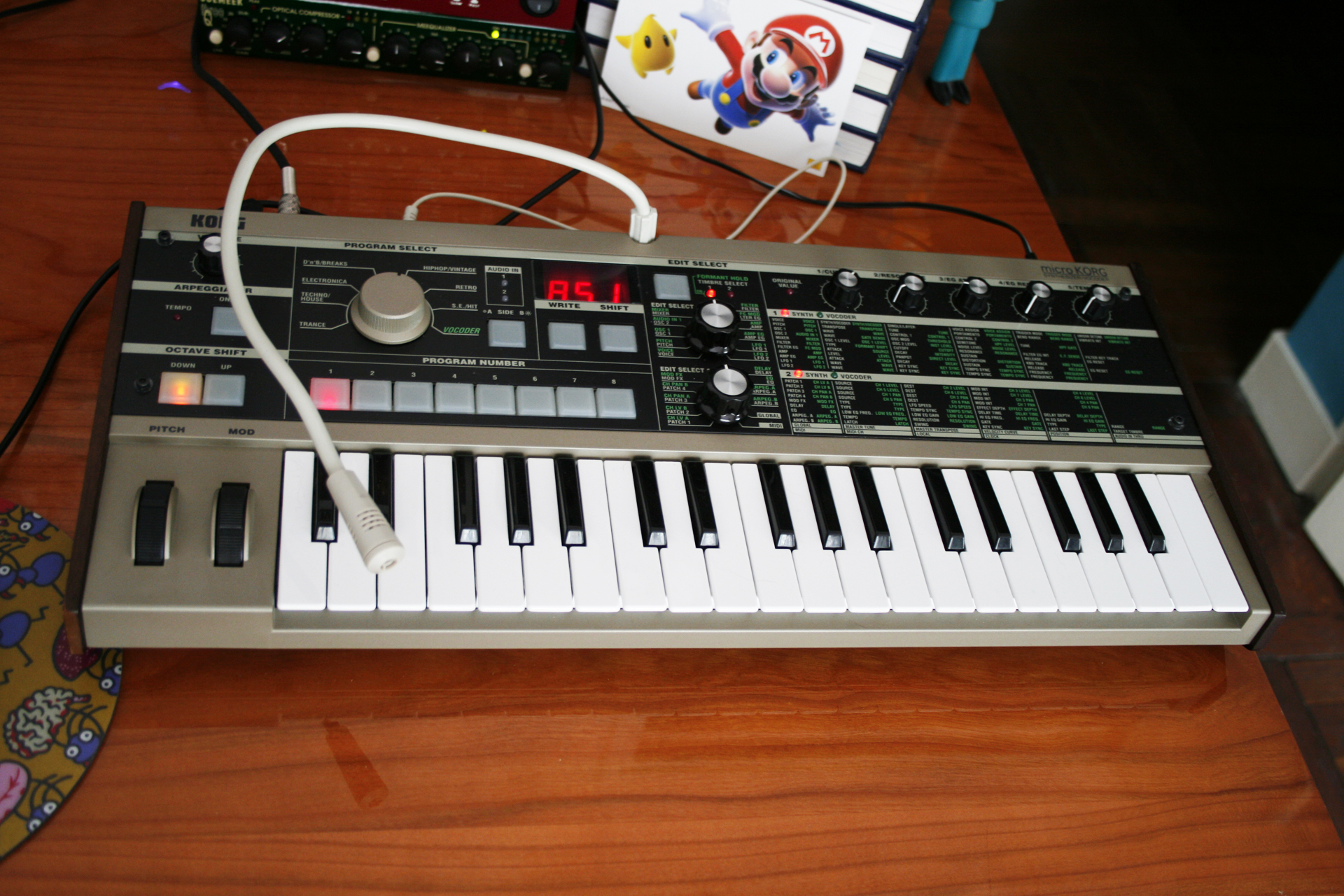
Korg Microkorg : polyphonic virtual analogue (4 voices), 2002… a most successful, retro looking and sounding instrument, often derided for its toy-like appearance, but it’s a serious, surprisingly deep instrument, with great arpeggiator and a vocoder full of character.
Korg Electribe EMX-1 : polyphonic virtual analogue (16 voices), 2003… most underestimated drum machine and synth module… great sounds, great effects, and a handy 5-parts synth sequencer, allowing you to program a whole song in there.

The digital collective :
Roland D-550 w/ PG-1000 programmer : polyphonic digital (16 voices), 1987... one of the finest digital synths ever, cleverly using truncated samples to add "realism", which sounds dated today but that's what I love in it! Great strings, ethereal pads, but also a fantastic source of strange effects.

Korg Wavestation : polyphonic digital (32 voices), 1990… another fine digital instrument, of outstanding depth. The lack of a proper filter renders the sound a bit cold, but it’s the perfect tool for soundtrack or ambient work. With a little bit of programming, a single patch can provide a whole complex atmosphere.

Yamaha QY70 : portable workstation… in my bag on most vacations and weekends, a great tool to work out song ideas on the move, with very decent sounds.

And various Bontempi, Casio and Yamaha...

Monday, May 11, 2009
Sergueï is Back
Another great Sergueï video, with new score...
"La séance de Sergueï" is a series of tongue-in-cheek cinema lessons by Simon Dronet...
It's in french, but I figured I might as well post this one here anyway because it's very visual and easy to understand.
This particular lesson is about split-screen, and I was asked to do an action tv series styled soundtrack.
Here's the music (you may notice there's more than in the actual video, which is often the case) :
This is the main chase cue... pretty much all Roland D-550, perfect to convey that "tv show fake strings" feeling...
This wasn't used... it's Prophet 08 for the beat and Roland D-550 for the fx.
This is the suspens bit... same setup.
A little fast paced techno fragment, done with the Korg Wavestation.
And the video itself :
LA SÉANCE DE SERGUEÏ #08 - "LE SPLIT SCREEN"
envoyé par laperitel - Sitcom, sketch, and standup comedy videos.
Tuesday, February 10, 2009
New free EP : Broken Sails
The new EP is here!


It was essentially done with the Prophet 08 as main instrument... if you listen to tracks 1 or 4, for instance, that's pretty much the fantastic synth from Dave Smith Instruments all the way through...

It's called "Broken Sails (Life in a Sinking Ship)" and the whole zip with complete CD artwork is HERE
If you liked it, be sure to give me feedback here or by email to khoralnet[nospam]free.fr
Thematically, "Broken Sails" is about XIXth sea travel... not really a concept album, but it's subtitled "Life in a sinking ship" because that's pretty much what the songs are all about... a dark, intense trip to India, set on a broken ship...
I took inspiration from John Cale's song "Captain Hook", the epic but introspective tale I covered some time ago for a compilation, and of course, the Conrad novel which lends its name to the opening track.
Musically, we're in lush analogue pop territory, with rich, warm textures and vintage drum machines.
Looking back, the sound is evocative of Dennis Wilson's incredible "Pacific Ocean Blues" album, with its dense, intricate wall of sound, but also Devo's synth-pop ("Heart of Darkness"), Dylan and REM's folk classicism ("Broken Sails") and Peter Gabriel's organic soundscapes ("The Ghost of India Supreme", which borrows its name from "Captain Hook" lyrics).
It was essentially done with the Prophet 08 as main instrument... if you listen to tracks 1 or 4, for instance, that's pretty much the fantastic synth from Dave Smith Instruments all the way through...
Save for that... well, whenever you hear bass, that's the Moog Little Phatty...
The strings on "The Fortune Song" are Gforce Virtual String Machine and there's some Roland Alpha Juno-1 as well on the instrumental parts for this track.
The opening chords on "Empty the Boat" are Korg Wavestation.
[Update] : archive.org version
Saturday, January 24, 2009
Gozer the Gozerian

I tried to capture the feeling of living in Gozeria
Gozer
Korg Wavestation and Roland D550 (the rack version of the oh-so-famous D50)
(On both synths I've switched the internal effects off, which is probably the first thing you should do if you want to program one, then add the nice hardware or software reverb of your choice!)
Thursday, January 15, 2009
Wavestation and Moog arpeggiator
 An instrumental track using the Korg Wavestation for the main pads and the new Moog arpeggiator...
Monday, January 12, 2009
Some thoughts about gear addiction
The last couple of years, I’ve been investing quite some time (and money) into rethinking my personal studio. I’ve changed my main synths, from cheap virtual analog to rather pricey analog ones, I’ve changed my audio interface, bought some preamps, compressor and mixer, and only this year, got three different instruments. That behavior, surely, begs the question : am I suffering from gear addiction?
First point to address is : what do you need to make music? It’s always been my belief that you don’t need expensive instruments or gear to make music. A 3000€ guitar has never ever turned a mediocre musician into a good one, and the same is true with synthesizers. There are on this planet a number of people able to produce insanely bad music with outstanding electronic instruments. I can prove it. I’ve seen the Youtube videos. You have too.
That said, what a pricier, more sophisticated synth might grant you is more versatility and higher quality sounds. When you want to add Moog sounds to your music, and can afford to go hardware, the best choice is a Moog synthesizer… which comes at a price. But it remains that every synth, no matter how primitive, can be put to intelligent use and good music.
The second point is : how much is too much? What’s the limit between reasonable acquisition of valuable gear and compulsive buying of new junk?
Let’s say first that the good thing about hardware instruments is that they occupy space. Yes, yes… I know that software proponents argue about how the virtual aspect of soft synths marks their practical superiority. I actually believe in the exact opposite. The trouble with software instruments or effects is that they don’t take any place at all. That’s why whether you’re using illegal software or not, you always seem to wound up with 150 synthesizers and 300 different effects, barely using three or four on a regular basis.
Regarding hardware synths, well, you have to make choices. Up to my purchase of the Prophet 08, I would say that my choice of getting a new instrument or not depended on my musical needs. I wanted a strong, analog polyphonic synthesizer to serve as the basis of my sound.
Other instruments I’ve bought second-hand, like the Wavestation or the Juno, were more a question of having different sounds at my disposal. It’s not really that I needed them, but it’s handy to have different possibilities, sound-wise. A Juno doesn’t sound like a Prophet, and obviously the Wavestation is no Moog. So, depending on the sound I’m looking for in a particular song, I have possibilites.

Am I addicted? I don’t think so. I realise that from now on, every synth I’m buying, I don’t really need. But here’s the third point : it’s fun to buy new toys. For months now I’ve been looking for a Roland D50, or better, the D550 rack version. Why? Because that’s one instrument that made me drool when I was a teen. It was the kind of big, fancy, pro, oh-so-expensive synthesizer I was hearing on all these late 80’s records I loved, one I couldn’t dream of owning. Now with a little bit of luck you can find a D50 for 250€, which is ridiculous considering the power of the machine, and the original price tag. Do I need one? Hell, no. Would I just love to play these classic 80’s sounds of my childhood? Hell, yes.
Sunday, December 28, 2008
Wavestation and Juno demo

A little sunday improvisation, kinda reminiscent again of John Carpenter's early soundtracks.
The clockworks and digital pad are Korg Wavestation, the rest is Roland Juno-1.
Stations
Sunday, November 30, 2008
Dolls (dissected)
A simple asian tune
After programming a vintage beat, I improvised the basic idea on the Wavestation : http://khoralnet2.free.fr/blog/Dolls-WS1.mp3
Then some more Wavestation : http://khoralnet2.free.fr/blog/Dolls-WS2.mp3
And Prophet 08 leads : http://khoralnet2.free.fr/blog/Dolls-prophet1.mp3
After adding a Moog bass drone, here's the final result : http://www.mediafire.com/download.php?mjkxyvjjfwj
There you are!
Wednesday, November 26, 2008
Korg Wavestation
The Wavestation is a great digital beast from 1990. I bought mine second-hand for 215€, which is a good deal considering the sonic qualities of that synth.
The Wavestation is indeed a nice piece of gear, with a reassuringly solid built (metal was used rather than plastic). Two points that should be looked closer if you consider buying one are the LCD brightness (it had a tendency to fade with the years, and can't easily be replaced (you can see on the pics that my own second-hand Wavestation has a very dimly lit screen) and the lithium battery (see here for details). It's a machine of respectable dimensions, and if you're already running out of space, the rack versions (Wavestation A/D and Wavestation SR, each one adding new features) or the software version (Korg Legacy) might be better choices.


So... what about it?
At first glimpse, the Wavestation suffers from the infamous "80’s interface" bug…. No knobs, but a LCD screen and some buttons. It sure looks slick, but what about programming? Well, I would certainly prefer a vintagish array of knobs to control the parameters in real time, but as digital synth design goes, I've seen worse than the Wavestation. The screen, after all, is quite big and although fumbling through menus and sub-menus isn't the most practical way to tweak the sound, everything is laid logically enough and with a little practice (because the manual is very thin), programming becomes somewhat easier. While the factory presets are decent (including the cool Mini Lead patch used by Tony Banks on "Fading Lights"), the Wavestation isn't a preset machine, but a real synth with vast programming capabilities.
audio example 1
audio example 2
audio example 3
This synth works with "performances", which are combinations of patches, each one able to stack up to 4 oscillators. That allows for very complex sounds, bearing in mind that the Wavestation is a vector synthesis synth, allowing the player to "move" inside the sound with a joystick (Dave Smith brought this to Yamaha and Korg from the ill-fated Prophet VS - my first synth was a Yamaha SY35, one of these surprinsingly rare vector synths). Toying around with the juxtaposition of patches, their respective envelopes, the split keyboard mode and the vector joystick is a perfect way to create rich, sophisticated, highly evolving sounds and landscapes.
audio example 4
audio example 5
audio example 6
This alone would grant you interesting creations, but the Wavestation has one more trick up its sleeve : wave sequencing. Simply put, it's a way of chaining waveforms in order to produce a rhythmic/melodic sequence (see pic below) that can then be supplemented with other patches, in unison or split mode. You can for example program a sequence for the left hand, juxtaposed with a bass sound, and a lead patch on the right hand, itself enriched by a pad… If programming a wave sequence will surely prove too scientific and tricky for most users, you can always tweak up an existing one by editing its waveforms and their duration, pitch, etc…... Of course, the overall effect is so distinctive that you can’t really use wave sequences that often in finished songs, but it's still a very fun way to experiment, improvise and try out ideas.

The Wavestation's main flaw, unarguably, is the lack of a proper filter. What we've got here is a digital non-resonant low-pass filter that doesn’t do much to shape the sound. This is really a pity, as we can but imagine how great the machine would have been with a good one, not even mentioning some bandpass, hi-pass or more exotic capabilities. Or even better, a combination of digital synthesis and analog filter, like what could be found on the Ensoniq SQ80. This serious issue forbids that the Wavestation produce any of the warm, smooth sounds of a D50, for instance, and explains why it excels in lush, but somewhat icy atmospheric pads and FX.
One final word about the built-in effects...… Like many digital synths, the Wavestation tends to rely heavily on them to make up for the relative weakness of its sound compared to that of an analogue polyphonic instrument. The effects supplied here are quite good, but I would definitely advise in most cases to turn at least the reverb off. This has a very metallic, harsh sound that needlessly contribute to the coldness of the sound. On the following audio example, a wave sequence is played, first with the built-in reverb the patch was created with, then with a VST hall reverb.
As you can hear, while the Wavestation's reverb provide for a peculiar ambience, it can prove difficult to make the whole patch work in the context of a whole mix. That’s why it might be a good idea to record the synth dry, even if it sounds a bit shallow at first, and then use a mellower, lighter reverb.
Useful links
http://www.danphillips.com/wavestation/index.htm
http://www.seriously-productions.freeserve.co.uk/wavestation/
http://www.soundonsound.com/sos/jun02/articles/wavestationtips.asp
http://www.soundonsound.com/sos/1994_articles/dec94/wavestationtips.html
http://www.soundonsound.com/sos/1995_articles/jan95/wavestationtips.html
http://www.music4moment.com/Stan/music/ws-tips.htmlhttp://www.korguksupport.co.uk/page.cfm?pageid=392That's all folks
Monday, November 24, 2008
Man is the Warmest Place to Hide

The man with the moustache is John Carpenter.
He has a nice moustache and he's quite a film maker as well, but he's also a damn great musician and synth aficionado...
I'm mostly fond of his late 70s/early 80s soundtracks, what with the vintagish gear and reverby drum machines...
If you aren't familiar with the work, I strongly suggest you go listen to the Halloween and Fog OSTs, and I positively order that you listen to the 1976 Attack on Precinct 13 (all right, here's the main theme, between you and me, http://www.mediafire.com/download.php?nznjonegqxi and yes, it's the Bomb the Bass sample)
The man has used a variety of classic instruments, most notably, and I'm so totally not-exhaustive :
Prophets 5 and 10 (Choice of the Year 1980 for HoboSynth Magazine)

Arp Quadra (notice that this particular synth has also been used by another famously moustached man) (but also Tony Banks from Genesis, which to the best of my knowledge has always been moustacheless)

Oberheim DMX (an excellent digital drum machine which I think he actually used, although I can't seem to find the exact reference now, so really you'll have to take my word on it... I mean, the wikipedia page doesn't mention him as a user but who you gonna believe, wikipedia or me? I mean, come on)

Arp Avatar (stolen from the gods of the keyboard bestowed on the disciples of the guitar, a legend that never made any sense to me)

So, in tribute to our man John and all the hellish moustaches of the underworld, here's a little instrumental track I did last Halloween.
That's all folks
Subscribe to:
Comments (Atom)