Remixed version of the "Deer Me" EP cover song.
Lots of Moog in there, I tells you.

Showing posts with label Roland D50. Show all posts
Showing posts with label Roland D50. Show all posts
Saturday, March 10, 2012

Tuesday, August 3, 2010
Retroblog : Patches Everywhere

Some synth sounds I've posted last year.
Moog Little Phatty
Endgame
(Hit a low key, hold it and put the mod wheel to maximum, for some apocalyptic and analogue crescendo).
Atari Forever
(Switch the arpeggiator on and toy around with bizarre chords and the mod wheel)
Prophet 08
Speedallish (Bank 1 - 25)
Electronic sequence, quite dynamic
DoublePad (Bank 1 - 35)
An experiment with the Prophet's dual layering : a low pad morphes into a higher one
4VoiceDreampad (Bank 1 - 36)
Another 4 voices analogue pad... use mod wheel to add some nice vibrato
Roland D50
The Bank
A complete bank of great factory sounds... it's mostly strings and pads, but note that the bank also features Jarre's sounds for the Revolutions album (the "Industrial revolution" intro sound, etc...) Please please, remember to back up your own bank before sending this sysex, because everything will be replaced!
If you need a freeware to manage all that stuff, try MIDI-OX.
Thursday, November 5, 2009
Roland D50

Yea! A synth review!
I've been using the Roland D550 (rack version of the famous D50) for months, so it's high time I say a couple words about it.
The Roland D50 was a big success, featured prominently on a number of late 80’s hit songs, in a lot of ways, as symptomatic of the era than the Minimoog for the early 70’s.
There are two kinds of things you might want to do with a D50 : eighties-type pseudo-realistic sounds (strings, etc...) and weird atmospheric sounds and FX.
That doesn’t mean that the instrument cannot perform in synth leads or pads, but my personal feeling is that you’d be well advised to go for an analog or virtual analog synth instead. The best lead sounds on the D50 for instance rely quite a bit on its faculty to add acoustic characteristics to the sound. While it may not sound like a Prophet or a Moog, none of these fine analog machines can produce the intricate, evolving, ethereal digital sounds the D50 provides.
The Korg Wavestation comes close, but in an even more experimental, cold way, whereas the Roland D50 retains that odd, pseudo-realistic quality that gives its sounds a texture not to be found anywhere else in the market.
Strings for instance are outstanding. Not because they sound real, mind you. They sound like real strings the way a Mellotron sounds like real flutes. Hence the appeal. They have that special, imperfect tone that gives a mix a certain edge you don’t get with high-end sample-based instruments. Now you wouldn’t use a D50 in lieu of the Vienna Symphonic Library to do a serious soundtrack, but for a pop song, well, it works.
Ambient strings and FX
While 1987 musicians probably purchased it for pads or leads, these prove a bit dated to many 2009 musicians. But where the D50 unarguably still shines is sophisticated and complex soundscapes, the kind of weird, otherworldy sounds that set up a whole cinematographic atmosphere or add extra layers of sonic oddities to an otherwise regular pop song.
This is weird
The D50 uses what Roland called Linear Arithmetic synthesis, and what we would now label as Sample+Synthesis. A full patch is made of 4 “partials”, that is, waveforms, assembled into 2 “tones”. The “partial” itself can either be sawtooth/square waveforms with pulse width or a PCM sample (out of a ROM bank of 100 samples).
The basic idea is that a good deal of what characterizes an acoustic sound is its attack. So, to save space while still giving a somewhat realistic feel to the sounds, Roland shortened the samples to the instrument’s attack, and looped some of them as well. The result is a mix of sampled attacks of natural instruments and classic synthetic waveforms that you can then alter with a fairly decent resonant filter and a comfortable array of modulation options.
The D50 uses what Roland called Linear Arithmetic synthesis, and what we would now label as Sample+Synthesis. A full patch is made of 4 “partials”, that is, waveforms, assembled into 2 “tones”. The “partial” itself can either be sawtooth/square waveforms with pulse width or a PCM sample (out of a ROM bank of 100 samples).
The basic idea is that a good deal of what characterizes an acoustic sound is its attack. So, to save space while still giving a somewhat realistic feel to the sounds, Roland shortened the samples to the instrument’s attack, and looped some of them as well. The result is a mix of sampled attacks of natural instruments and classic synthetic waveforms that you can then alter with a fairly decent resonant filter and a comfortable array of modulation options.

Synthesis itself is your usual subtractive synthesis with low-pass filtering. Playing around with the partial and tone configurations, the keyboard split-points and the three LFOs along with their complex envelope generators is sure to make for most interesting, sophisticated soundscapes.
While the D50 isn’t a workstation, you’ll find integrated reverb and chorus. I strongly suggest that you switch these effects off altogether, even if the patch sounds less impressive at first. Just work out a good patch without effects, and add the external reverb of your choice. While the chorus is all right, the reverb has that nasty, metallic sound we have come to know and loathe from the early days of digital synths.
I had read somewhere that with the Juno-1 and its PG-300 expansion, Roland had made programming optional, but that’s a bit extreme – while the programming interface is sorely lacking, you can still, if you’re motivated, produce your own sounds. The statement rings a lot truer with the Roland D50. Interface-wise, here we stand in a desolate, 1980-style landscape with no hope of doing any serious programming without buying the optional PG-1000 programmer or using software. If you can program a sound from scratch on the Roland D50 alone, congratulations, you have the patience of a saint.
I myself prefer the hardware option, which gives you instant access to most parameters, and turns the Roland D50 into a fabulously expressive instrument. I have to admit, the PG-1000 is somewhat cluttered, and it’s sometimes hard to be sure what will happen when you push this or that slider, but on the other hand, it makes the whole thing quite unpredictable and exciting. At minima, the PG-1000 allows you to tweak factory patches to your liking in a more user-friendly way, but what makes the controller a great addition if you can afford it, is being able to fiddle with that über-digital synthesizer like you would on an old-fashioned analogue.
The Roland D50, like most digital synths of that era, can be found for less than 200€ (and count something like 120-150€ for the PG-1000). It’s all good for the musician who’s looking for a cheap but professional synthesizer that still have tons to offer in terms of experimentation.
There was a hint of nostalgia in my own research of a D50, that is, the simple pleasure of owning a great instrument that had me dreaming when I was a teen, and playing some of these classic late eighties patches.
Demonstration of factory patches used by Jarre
The oh-so-famous Orinoco Flow sound
But obviously the D50 is a lot more than just an artifact of music technology, it’s a fine instrument with a character of its own and outstanding value-for-price ratio.
The oh-so-famous Orinoco Flow sound
But obviously the D50 is a lot more than just an artifact of music technology, it’s a fine instrument with a character of its own and outstanding value-for-price ratio.
Some D50-heavy songs :
Resources:
A page to preview all the factory patches Sunday, October 4, 2009
Overdrive that Korg
 Just having some fun with the toys...
To explain a bit what's going on in this improvisation :
- The Electribe EMX is playing the beat, which is fed to the TL FAT1 compressor with the input gain on maximum so that it's distorting like craze
- The Moog bass is sequenced by the aforementioned Electribe
- The Roland D550 does it fx/digital/weirdiness thing
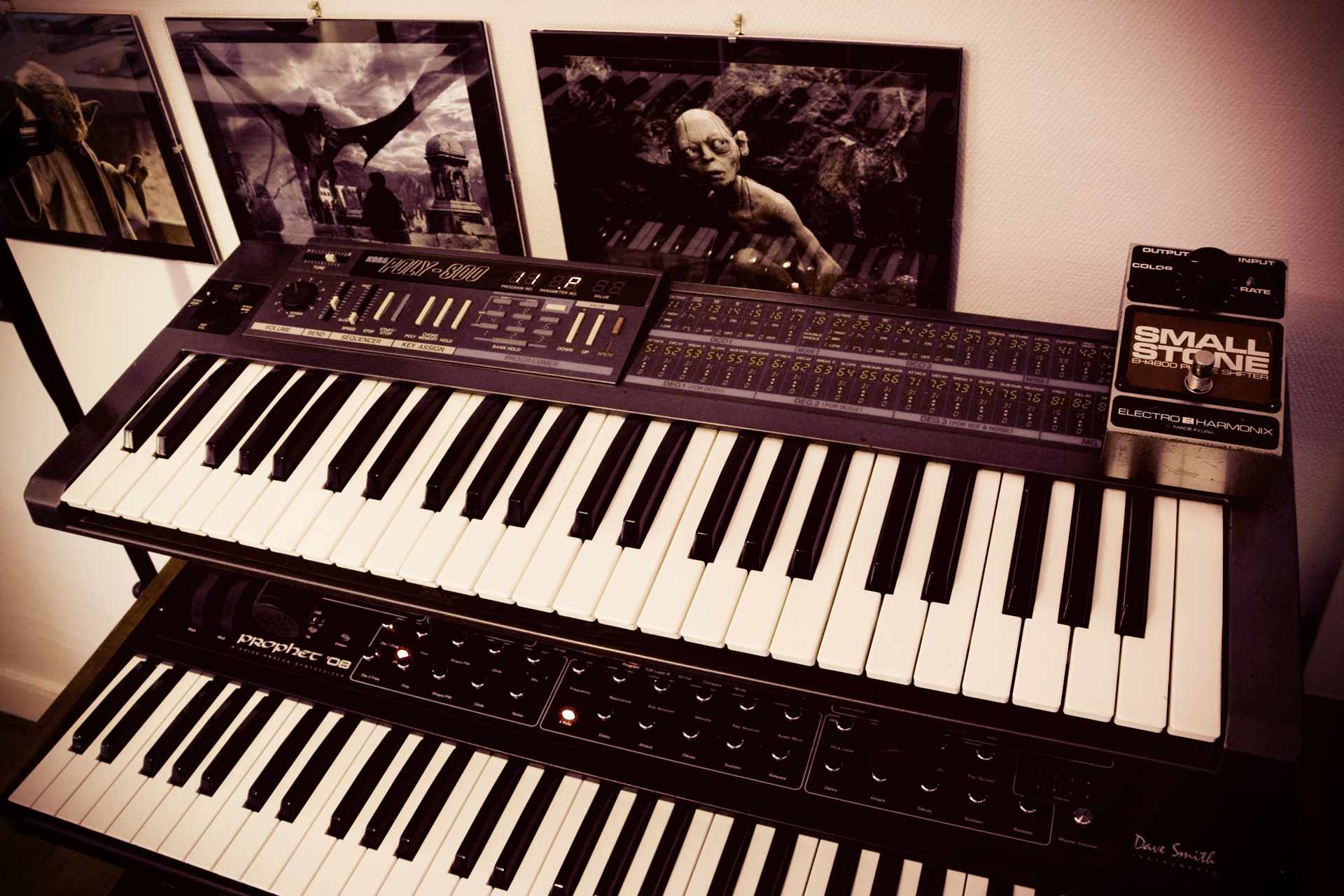
- The Korg Poly-800 pads are passing through the Small Stone phaser pedal
- The cat is staring rather nastily at me (out of frame)

Monday, July 20, 2009
Let's Go Digital : Wavestation and Roland D50

... it's been a while.
Short improvisation with the Korg Wavestation and Roland D50 (or should I say, D550, the rack version).
Thursday, May 21, 2009
Showroom Dummy

Now that my setup is complete (I mean, for the time being), I think the time is ripe for a little explanatory tour.
As you can see, my studio is mostly hardware, which I tend to prefer for workflow and audio quality.
As usual, the pics links to higher resolution images.
The analogue bunch :
Moog Little Phatty : monophonic analogue, 2006 Tribute Edition, the signature Moog sound, all basses on my songs are played on this, and obviously it excels in leads. With the new arpeggiator, it's also a good source of interesting effects.

DSI Prophet 08 : polyphonic analogue (8 voices), 2007... beautiful and sophisticated sound. It's the instrument I usually use for lush, warm textures. The on-board sequencer and the ability to layer two patches are most useful to create loops and percussive grooves.

Roland Alpha Juno-1 : polyphonic analogue (6 voices), 1986... this is the one for eighties sounds with a lo-fi, dark edge. The classic Juno sound, in a punkier sort of way.

The virtual analogue connection :
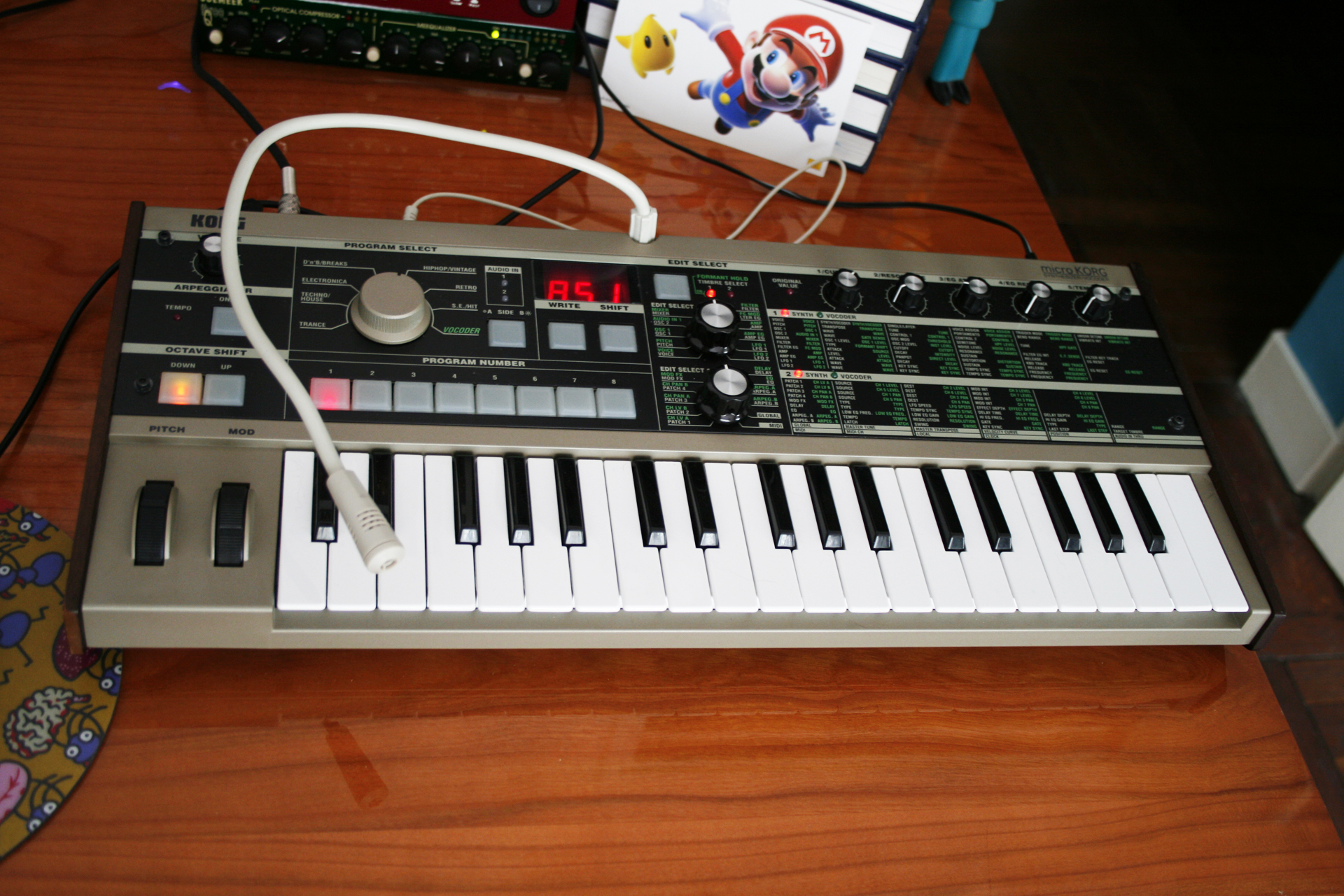
Korg Microkorg : polyphonic virtual analogue (4 voices), 2002… a most successful, retro looking and sounding instrument, often derided for its toy-like appearance, but it’s a serious, surprisingly deep instrument, with great arpeggiator and a vocoder full of character.
Korg Electribe EMX-1 : polyphonic virtual analogue (16 voices), 2003… most underestimated drum machine and synth module… great sounds, great effects, and a handy 5-parts synth sequencer, allowing you to program a whole song in there.

The digital collective :
Roland D-550 w/ PG-1000 programmer : polyphonic digital (16 voices), 1987... one of the finest digital synths ever, cleverly using truncated samples to add "realism", which sounds dated today but that's what I love in it! Great strings, ethereal pads, but also a fantastic source of strange effects.

Korg Wavestation : polyphonic digital (32 voices), 1990… another fine digital instrument, of outstanding depth. The lack of a proper filter renders the sound a bit cold, but it’s the perfect tool for soundtrack or ambient work. With a little bit of programming, a single patch can provide a whole complex atmosphere.

Yamaha QY70 : portable workstation… in my bag on most vacations and weekends, a great tool to work out song ideas on the move, with very decent sounds.

And various Bontempi, Casio and Yamaha...

Tuesday, May 12, 2009
Harry S. Truman at Hiroshima (Final Cut)

This is the final version, expanding on the sketch posted some days ago.
Roland D-550 strings, Prophet 08 pads, Moog Little Phatty bass and lots of Gforce Mellotron.
Monday, May 11, 2009
Sergueï is Back
Another great Sergueï video, with new score...
"La séance de Sergueï" is a series of tongue-in-cheek cinema lessons by Simon Dronet...
It's in french, but I figured I might as well post this one here anyway because it's very visual and easy to understand.
This particular lesson is about split-screen, and I was asked to do an action tv series styled soundtrack.
Here's the music (you may notice there's more than in the actual video, which is often the case) :
This is the main chase cue... pretty much all Roland D-550, perfect to convey that "tv show fake strings" feeling...
This wasn't used... it's Prophet 08 for the beat and Roland D-550 for the fx.
This is the suspens bit... same setup.
A little fast paced techno fragment, done with the Korg Wavestation.
And the video itself :
LA SÉANCE DE SERGUEÏ #08 - "LE SPLIT SCREEN"
envoyé par laperitel - Sitcom, sketch, and standup comedy videos.
Tuesday, April 28, 2009
The Good, the Bad and the Synth

A little sketch recorded for a Western animation video.
The project is still far in the future and the music will most probably change a lot, so I might as well post it here now...
I was asked to do a short atmospheric tune, in a very clichéd Western style.
As you can hear, this is too synth-ish, that's something that'll be toned down for sure in the final version.
Prophet 08 drone, Roland D-550 strings and Gforce M-tron for the nice cello at the end...
And bluesy slide guitar... I have to say I'm quite happy with the way it was recorded, I rarely record steel guitar that well, eheh.
Wednesday, April 8, 2009
Here Today Gone Tomorrow

Guitar and Roland D-550.
As a distraction from my own music (working on the final digital release of my "Strawberry Blonde" full-blown album), a little cover from the Strawbs (now that's thematic), a somewhat obscure but good band (wiki)
Sunday, March 29, 2009
Roland Inside : Jarre meets Art of Noise

Nothing serious at all here!
Just some silly fun with the Rolands D-550 and Juno...And a music quizz : tell me which three instrumental tracks from the 80s are referenced here.
The correct answer wins a Moog Voyager (if I can get Moog Music interested in this fascinating challenge, otherwise you'll get all my consideration).
1889
Tuesday, March 3, 2009

Monday, February 9, 2009

Roland PG-1000

Until the time I get to write a review, some hi-res pics of the Roland PG-1000 programmer, which is the dedicated interface for the D-50 and D-550 synthesizers... unless you use a software editor (which I don't find very convenient) or have the patience of a saint, there's no way you can program one of these instruments without this.


Roland D50 patches

It's patch time!
Let me say first that these aren't my sounds... with an interface that crappy, I haven't really had the time and/or the energy to get to serious programming yet.
What I've done, on the other hand, is compiling all string and pads I could in one sysex file.
This was mostly for my purposes in the short term, but then I thought it might be useful to other new owners.
The BankSo, if you just just purchased a Roland D50 or D550, you can use this sysex to load a complete bank of great factory sounds... it's mostly strings and pads, but note that the bank also features Jarre's sounds for the Revolutions album (the "Industrial revolution" intro sound, etc...)
Please please, remember to back up your own bank before sending this sysex, because everything will be replaced!
Also, if you need a freeware to manage all that stuff, try MIDI-OX/
Thursday, February 5, 2009
In the Twilight Zone

A short "dramatic retro" instrumental...
Sample from the 1960 Twilight Zone episode "The Big Tall Wish".
Prophet 08 and Roland D550.
What the World is Made of
"Little boys with their heads filled up with dreams [...] When do they suddenly find out that there aint any magic? When does somebody push their face down on the sidewalk and say to them, "Hey little boy, it's concrete. That's what the world's made out of, concrete." When do they find out that you can wish your life away?"
Sunday, February 1, 2009
The Stately Trees

Originally sung by a certain Regina Mathews.
I ran across her through The Record Robot
It is a children song, from a surprisingly clever and sophisticated album, with tasteful songwriting and simple lyrics verging on the surrealistic
Proof that you can do a children record that isn't stupid and crass (I'm looking at you, every singer who is not Regina Mathews).
Small Stone guitar, piano and Roland D-550
Friday, January 30, 2009
Sherman Filterbank Extravaganza
 The Sherman Filterbank 2 is, to quote the official site, "a powerful analog filtering and distortion unit with a huge frequency range and a killing TUBE overdrive behavior".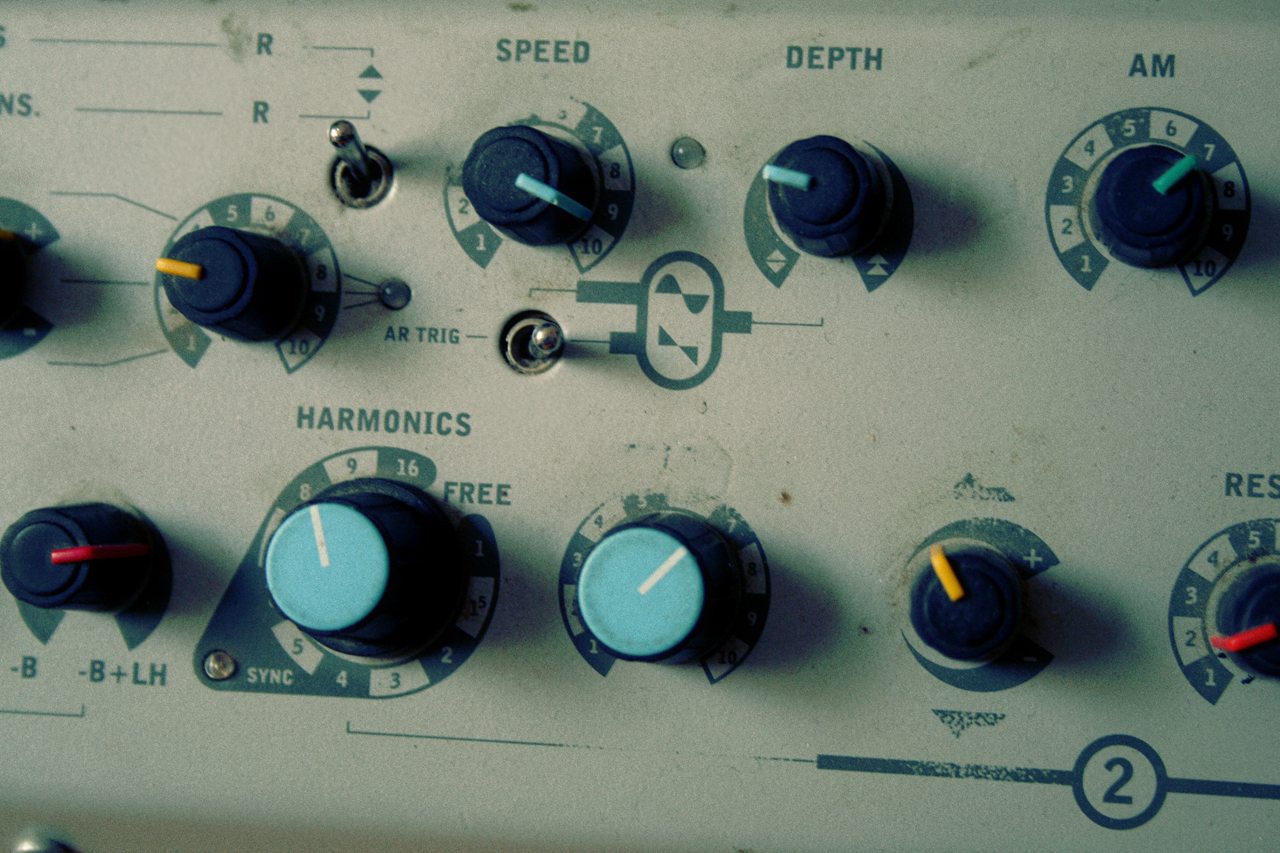
This particular unit I have on loan these days, and as you can tell from the pictures (click for higher res), it clearly has seen better days... I've been listening to the official demos and I'm not quite sure it isn't damaged in some way...

In any case, everything I fed to it came out as sonic mess, with the knobs having little or no effect.

This is, uh, the most listenable thing I could come up with!
Death to MoogProcessed guitar and Roland D-550 (which I will continue to tag as Roland D-50 for clarity sake, since it's the same synth anyway)
Saturday, January 24, 2009
Gozer the Gozerian

I tried to capture the feeling of living in Gozeria
Gozer
Korg Wavestation and Roland D550 (the rack version of the oh-so-famous D50)
(On both synths I've switched the internal effects off, which is probably the first thing you should do if you want to program one, then add the nice hardware or software reverb of your choice!)
Subscribe to:
Posts (Atom)