Sunday, December 29, 2013
Casiotone MT11 Review
Monday, October 29, 2012
Arturia Minibrute : Early Impressions
Tuesday, February 22, 2011
Bye-Bye Juny
Another good soldier gone, but I wasn't using much the Juno-1 apart from the live act, and a newcomer from Korg got here this weekend (more on that tomorrow).
Again, to celebrate this fine instrument, let's repost the review.
The Alpha Juno-1 is a 1986 analogue polyphonic synthesizer from Roland.
It's also a very underestimated instrument.
The latter argument is irrelevant and probably uttered by persons who either have never actually played a Juno-1, or else have rotten burgers in lieu of ears. Since I can’t believe that there might be people on the internet with nothing better to do than bashing instruments they didn’t really play, I can only assume there is a rampant wave of burger infection affecting the synth-oriented population.
DCOs have received a considerable amount of scorn from analog purists all along the years. I don’t think they deserve it, because they made possible cheaper analog synths that regular musicans could actually buy, and reliable analog synths that regular musicians could actually bring on tour without having to fear night after night that the big fat analog chord that was supposed to bring the audience to their knees would come out as a pathetic yoink because of a nasty oscillator detune. Good DCOs don’t compromise sound quality as much as their detractors pretend. I actually read in a Juno-1 online review that since this Juno moved to DCOs, it sounded more digital than the VCO-based Juno-60. This, of course, is wrong, since all Junos are DCO-based. The reviewer could nonetheless tell the difference between the Juno-1’s DCOs and the Juno-60’s imaginary VCOs.
About the alleged coldness of the Juno-1, to be frank, these endless debates about “warmth” and “fatness” are somewhat tiresome to me, and trying to figure out by ear which Prophet revision sounds “warmer” is more likely to put me to sleep than a Lars Von Trier movie (I’m kidding, of course, I’ve seen “Dancer in the dark” and there’s no way you can fall asleep when assailed by such vapid nonsense).
Warmth, for one thing, is very subjective, and when discussing synths, it’s always useful to remember than our perception of analogue synthesizers as being “warm” relies on the way our ears are trained to grasp subtle nuances in audio quality. To most people, all synths pretty much sound “synth-ish”, and we all heard time and again music lovers averse to electronic instruments say that they were cold and lifeless, and I’m talking about the very same beloved analogue gear we know to be “warm” and “fat”.
The Alpha Juno-1 is very compact, quite a small instrument with a four octaves keyboard. Very unfortunately, it isn’t velocity or pressure sensitive (unlike the bigger Alpha Juno-2), which means that although it’s not a rack, you might want sometimes to control it with a master keyboard.
Juno tweaking
The interface, let’s face it, is an abomination. All parameters, displayed on a tiny screen, are accessed by a combination of the big dial on the left, and the value button. This is, ha, I can’t even find the words to describe how unconvenient it is, so I’ll invent one, it is the one of the schprotziest synth interface I ever seen. There’s worse, but not many. Picture yourself programming a sound on the Juno-1. First you push “Parameter select”, then turn the dial clockwise to get to the parameter you want to modify, let’s say the chorus effect. Then push “Value”, then the dial again to change the value. Then “Parameter select” again, then the dial again to get to the next parameter, say the sub-osc level. Then “Value” again and the dial again to modify the value. And so on… That is tedious, dull, boring, well, total schprotz.
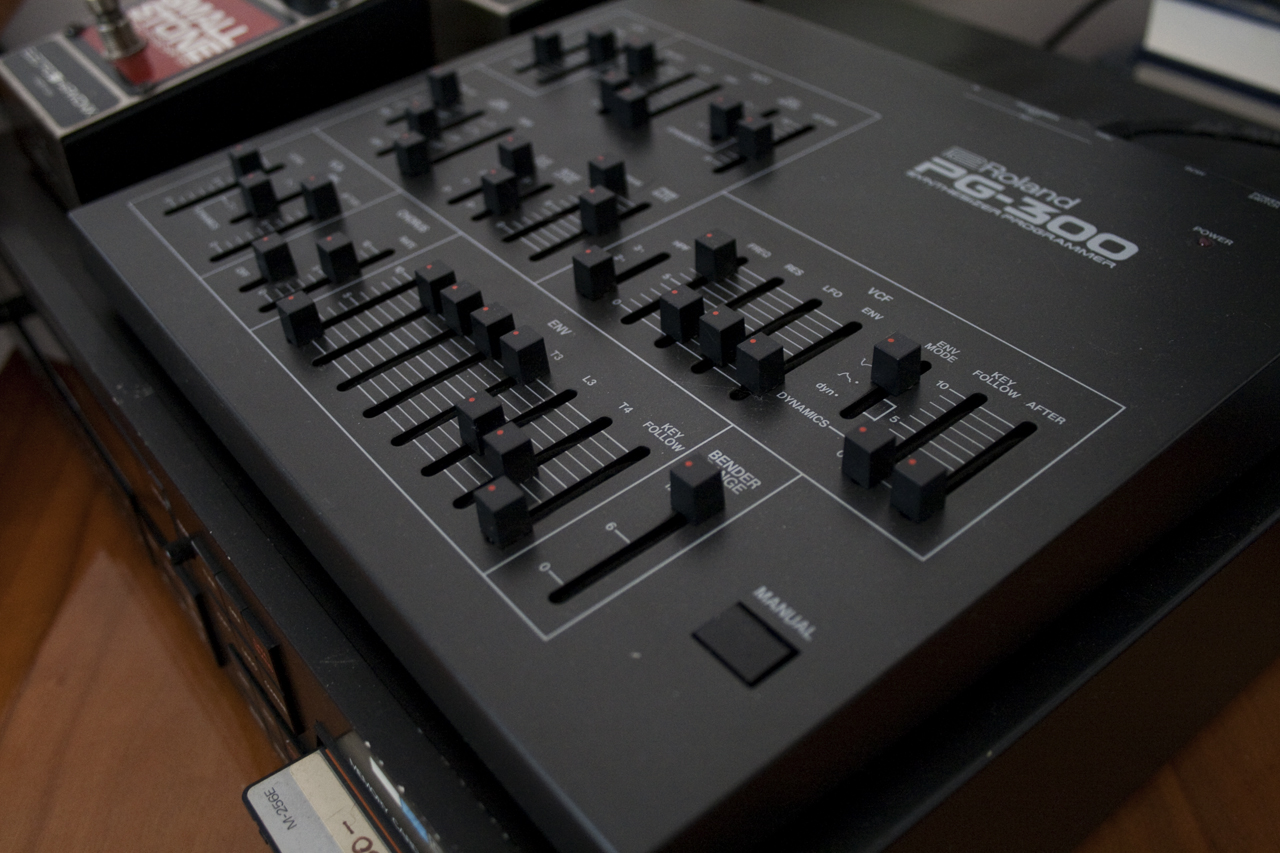
What you want to do for serious programming is get the PG-300 programmer along with the synth itself. The prices fly high and it’s not unusual to find the programmer at the same price than the synth. Now, I wouldn’t go as far as saying that Roland “made programming optional” (I’ve read that in an ebay bid some time ago). If you’re dedicated to creating your own sounds, I think you can cope with the schprotz, and there are some software editors to help you.
The combination of Juno-1 and PG-300 should probably be considered like the complete Alpha Juno synthesizer, and very often you’ll find both on sale as one package. The Juno-1 itself may be one of the cheapest analog synth on the market (I’ve got mine on ebay for 180€). Add the PG-300 and you jump to the prices of a reasonably priced Juno-106 or Juno-60, which begs the question : why would you buy an Alpha Juno instead of a Juno-60, for instance?
Let’s begin to say that it does have that special 80’s analog Roland sound. Is it a Juno-60? Well, the answer is in the question. People who criticize the Alpha Juno for not sounding exactly like the Juno-60 must be the same kind who criticize the Prophet 08 for not being a Prophet 5. Just as the Prophet 08 is a Prophet, not the Prophet 5, the Alpha Juno is one kind of Juno, with a distinctive quality shared by all Junos, but in a darker, muddier flavour.
Whether it’s a good choice depends on the kind of sounds you’re after. It’s true that the Alpha Juno lacks the visual appeal of the other Junos. It is a rather bland, unremarkable black thing. It’s also true that it lacks an arpeggiator. But sound-wise, the difference is a matter of taste. The Juno-60 sounds more “educated”, while the Alpha Juno seems to drift closer to SH-101 territory. I love that actually. There’s a special gritty quality to the Alpha Juno that eludes the other Junos, and which I find very complementary to my smoother Prophet 08.
The Juno-1 works on a single oscillator with a choice of sawtooth and pulse, but also noise and 6 sub-oscillators. This is quite sparse, so a built-in chorus is added to fatten the sound a bit. Of course, it has been suggested that Roland needed on-board chorus in order to make the synth sound good. So what? There is no such thing as “cheating” in synthesizer design. The aim is to make a good-sounding instrument, right? How you achieve that aim is irrelevant. The chorus is intregral part of the audio chain that makes the Juno sound, and arguing that they wouldn’t sound as good without the chorus is like criticizing the Minimoog for not sounding as good without its third oscillator.
It's a good chorus, but you can choose to bypass it and put your own external effect unit. On the following example, the first part is played with the on-board chorus. The second and third are played with the on-board chorus off, and the Juno-1 passing through a Electro-Harmonix Small Clone pedal at two different settings.
There’s a very useful chord memory function. Simultaneously press the chord memory and write button, then hit a chord. When you release the keys, the chord is memorized. Switch chord memory on, and each key triggers the whole chord. This is more than a fun gimmick, as it allows you to play chord blocks like you would play a mono line, with the voices being instantly reallocated to each new chord.
If instead of memorizing a chord, you memory a single note, what you get is a mono Juno…. But then try memorizing something like C1-C2-C3 and you’ve come across a nice way of creating complex mono leads.
Overall, the Juno-1 is a great instrument, with plenty of character, and in a way it’s thankfully underestimated, because that allows for a very affordable street price. I found it to be reliable, although my unit has a tendency to “forget” its first 8 user presets from time to time. The oscillators are of course very stable, but they remain analog… the Juno-1 may sometimes sound a bit odd in the first minutes, until it gets warmer. It is definitely a bargain polyphonic analog, that I would recommand any time against VSTs in the same low price bracket.
Sunday, May 16, 2010
Alesis Nanoverb
Papa's got a brand new verb!
Well, allright, this isn't exactly new : I've just found it at a garage sale for virtually nothing, and it seems in perfect working order.
The Nanoverb is Alesis's 1996 mini digital reverb unit, on the trail of the Microverb I and II. It's small, and I mean, really small, roughly the size of a guitar pedal. The built is sturdy and trustworthy and the layout couldn't be simpler : 1 Input Gain knob, 1 Output Gain, 1 Mix balance, 1 Preset selector and 1 Parameter adjustment knob.
Yeah, you've heard me : only one Parameter knob, which is pretty drastic, but keep in mind it's a very simple, budget unit.
The Nanoverb features 16 ROM presets.
First, of course, the reverbs.
3 Concert Hall, 3 Room, 3 Plate reverbs : they're all very good, with special mention to the Room algorithm. Not that you will get the natural, lush sound of a pricey Lexicon, but the Nanoverb still produces a nice, moody atmosphere to any track, without getting too metallic or brilliant.
1 Nonlinear reverb (to quote the manual : In the mid '80s, a certain British producer/engineer (who shall remain anonymous) discovered a clever way of creating a huge drum sound. He would place the drum set in a large, reverberant room, mic the room and chop off the end of the reverb tail with a noise gate. When this sound caught on, digital reverbs began to be released with a "Nonlinear" program, which simulated this effect. In the end their simulation became more widely used than the effect it was trying to emulate, and the non linear reverb earned it's place in effects history).
When a reverb is selected, the Parameter knob adjusts the decay.
Then, the "pitch based effects".
1 rather uninspiring Chorus, 1 semi-decent Flanger, 1 usable Rotary, and a couple of more interesting Chorus/Room algorithms.
I've recorded these three demos with the unit.
1. A very digital sequence (a most famous D50 factory patch), first dry, then passing through the various pitch-based presets and tweaking them.
2. A very analog pad from the Prophet 08, with various heavy reverbs.
3. The same D50 sequence, this time using the other effects..
Finally, the specs:
Electrical Frequency Response: ±1dB from 20Hz to 20 kHz
Dynamic Range: >90dB "A" wtg., 20 Hz-22kHz
Distortion: <0.009%><0.005%>
Crosstalk: <90db>
Input
Number of Channels: 2
Format: 1/4" unbalanced
Nominal Level: -10 dBV, adjustable to +4 dBu
Maximum Level: +10 dBV
Impedance: 1MW/channel stereo, 500kW/channel mono
A/D - D/A Conversions
A/D converter: 18 bit Sigma-Delta, 128 times oversampling
D/A converter: 18 bit Sigma-Delta, 8 times oversampling
Output
Number of Channels: 2
Format: 1/4" unbalanced
Maximum Level: +17.5 dBu
Nominal Level -20 dBV or +4dBu, front- panel adjustable
Output Impedance: 500 ohms
Power 9 Volt Power Transformer (Alesis P3)
Processor Speed: 3 MIPs (million instructions per second)
Internal processing resolution: 24 bit accumulator
Factory Preset Programs (ROM): 16
Tuesday, April 13, 2010
Korg Poly-800


The reviews are back!
Today's Item : the analog polysynth Korg Poly-800.
First, to have something relevant to listen to while reading this little review : the following track is all Korg Poly-800.
Mutant Monty by khoral
The Korg Poly-800… here’s a quirky synth for sure.
It may look like a toy or home keyboard, but it’s a real, vintage analog synthesizer with plenty of retro character.
The interface (or lack thereof)
Now of course, this is a 1984 instrument, so don’t expect useful stuff like, I don’t know, KNOBS. What you get is a numerical board, a couple of value buttons and a graphical layout so you can understand what’s going on.
Programming obviously isn’t as easy and straightforward as it should, but as 80’s interface design goes, it’s decent. It certainly beats the Roland Juno-1, which is much more of a pain to program without its PG interface.
Oddly enough, Korg used sliders for functions like Pitch bend range or Oscillator tuning, at which point I should remind you that these are DCO, or digitally controlled oscillators, and they’re very stable. Why the dedicated slider, instead of a couple ones for filter cut-off/resonance, I have no idea.
The joystick is actually more than a simple pitch bend, as it also controls modulation and filter, a really nice feature.
The built is cheap, all plastic and please, please, beware of the fragile joystick, but its simple design seems to have aged very gracefully. Mine works like a charm anyway.
It works on batteries (yeah!) and again, because it’s 1984, you’ll find buttons on each side to use with a guitar strap.
Synthesis (play up to 8 notes at a time! with 1 single filter!)
Wait, did I say it was a 8-voices synthesizer?
Well, on the paper it is. If you only use one oscillator for your sound, a polyphony of 8 voices is what you get, but also your sound will often be thin and uninspiring.
For a richer sound, you’ll want to switch to the so-called Double mode, using both oscillators and reducing the polyphony to 4 voices.
Limited, eh? But it wasn’t so long ago you only had 1 voice, so…
I myself like the effect of notes stealing voices from one another on a limited polyphony instrument.
And speaking of limitations, let’s come to grips with the biggest : all oscillators pass through the same low-pass 24dB filter. So if you play legato, the filter envelope will trigger for the first note only, which makes for some funny playing.
This is a big limitation but one that I rather like, as it’s another quirk that adds up to a very distinct character.
The filter itself is a fine one, best suited for retro pads, sizzling analogue leads and early 80’s synthpop magic. A Polarity function allows for filter envelope inversion.
The oscillator section is quite interesting, as the Poly-800 uses additive synthesis to generate waveforms. The basic material is a squarewave, while on top you’ll add different harmonics at octave intervals, the volume of which reacts according to either a sawtooth or a squarewave form (that is, if you choose sawtooth, the volume curve of the various harmonics will be shaped like a sawtooth). Oscillator 2 can be be transposed on a full octave.
In Roland Juno fashion, Korg has added a great chorus, which should be considered an integral part of the audio chain.
Envelope (as in : lots of 'em)
Also notable is the rather complex envelope section. Each oscillator sports its own 6-stages envelope : Attack, Decay, itself split in two at Break point, with Slope setting up the time for envelope to go to Sustain, and finally Release.
If the Break point is set at a lower value than Sustain, what you will hear is the Attack, then Decay, a second Attack, and up to Sustain. A good way to create more sophisticated, evolving sounds.
The LFO section, on the other hand, is a bit primitive. A sinewave LFO controlling VCF and DCOs, and that’s it.
Extras
The Key Assign section too is reminiscent of my Roland Juno-1.
The Poly mode is the standard polyphonic mode you’ll use most of the time.
In Hold mode, notes will keep sounding until their voices are reallocated, as if all release values were set up on infinite.
Chord memory, often mistaken for a useless gimmick, is a great tool to create interesting sounds. Press Hold, then play a chord, hold it and press Chord memory. Every note will rep. Play a single C note instead and you’ve got a monophonic synth.
Finally, the Poly-800 features a simplistic 256 events sequencer and early MIDI.
So what?
Sonically, the Poly-800 falls square into the early 1980’s fuzzy, raw, poppy analogue family, and because it’s so overlooked, you’ll often be able to find a working unit for ridiculously low prices.
I bought mine 111€ shipping included on Ebay, and for such a fine analogue synthesizer, it’s basically a steal, so if you’re looking for eighties-styled analogue, and hesitate to pay 600€ or more for that soooo hip Juno-60, consider getting the Poly-800 instead, it’s no Juno-60 all right and you won’t show off with it, but it’s great value and I hardly think you’ll regret it.
I sure as hell don't.
Sunday, March 7, 2010
Electro-Harmonix Round-Up : 6 Reviews

Tuesday, December 1, 2009
Revised Review : Prophet 08

Going on my 1-year blog anniversary retrospective, here's a consolidated/revised review of the Prophet 08, which I first oversaw on dec. 3rd 2008. I've added a deeper review of the internal sequencer and lots of audio snippets and songs made only with the Prophet 08.
Prologue : there are two ways of testing a synth in a music shop. The first is to peruse the factory patches for 15 minutes and rush back home to post on the web how bad a decried instrument fare against this or that so-called vintage classic. I like to call this the Retarded Way. The other one is, with previous knowledge of the basic functions of the instrument, to carefully test each function and try to imagine beyond the factory settings how good it'd be for you.
This is 2009, not 1978 : the Prophet 08 isn’t the Prophet 5. It's not the same name, you see. One is called 5, and the other is called 08. The difference in naming tells you that it is a different instrument. If you've followed my reasoning so far, let's add that it isn't that important to decide if it's a real Prophet or not. It's more relevant to judge the instrument for itself. But our good man Dave called it a Prophet, so I might as well take a side : I do believe it's a Prophet, that is, true to the Prophet line.
The sound is rich and musical (possibly light on the low-end on pad sounds, but that's actually a bonus in my book, since it usually fits better in the mix for that very reason). Not all analogues need to be gritty... some, like the aforementioned Xpander, are smooth and sophisticated. The Prophet 08 fits in that category, while still being able of nasty, snappy sounds. In any case, it wouldn't be the first analogue gear to be found unimpressive by early "specialists", then to be considered a classic...
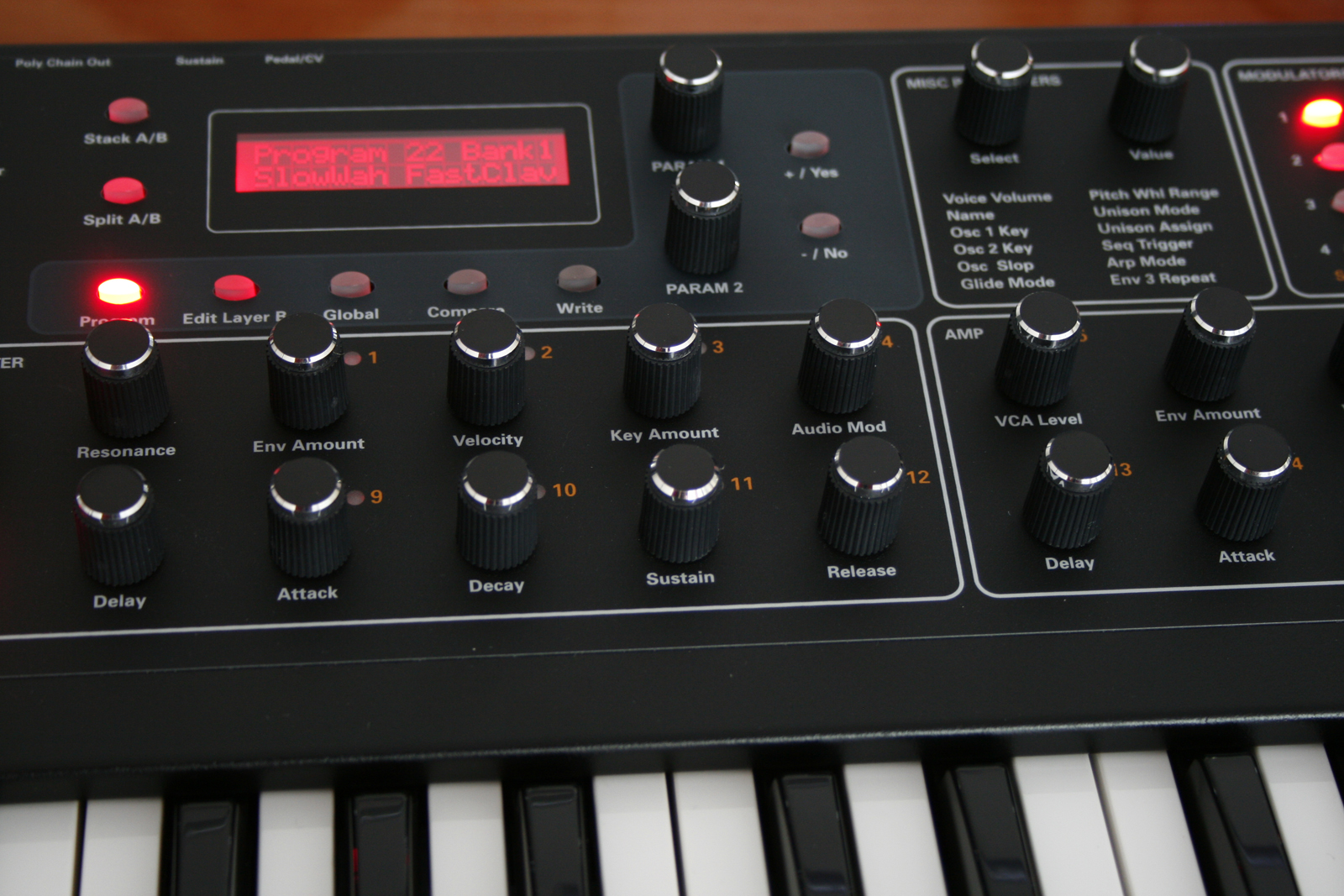
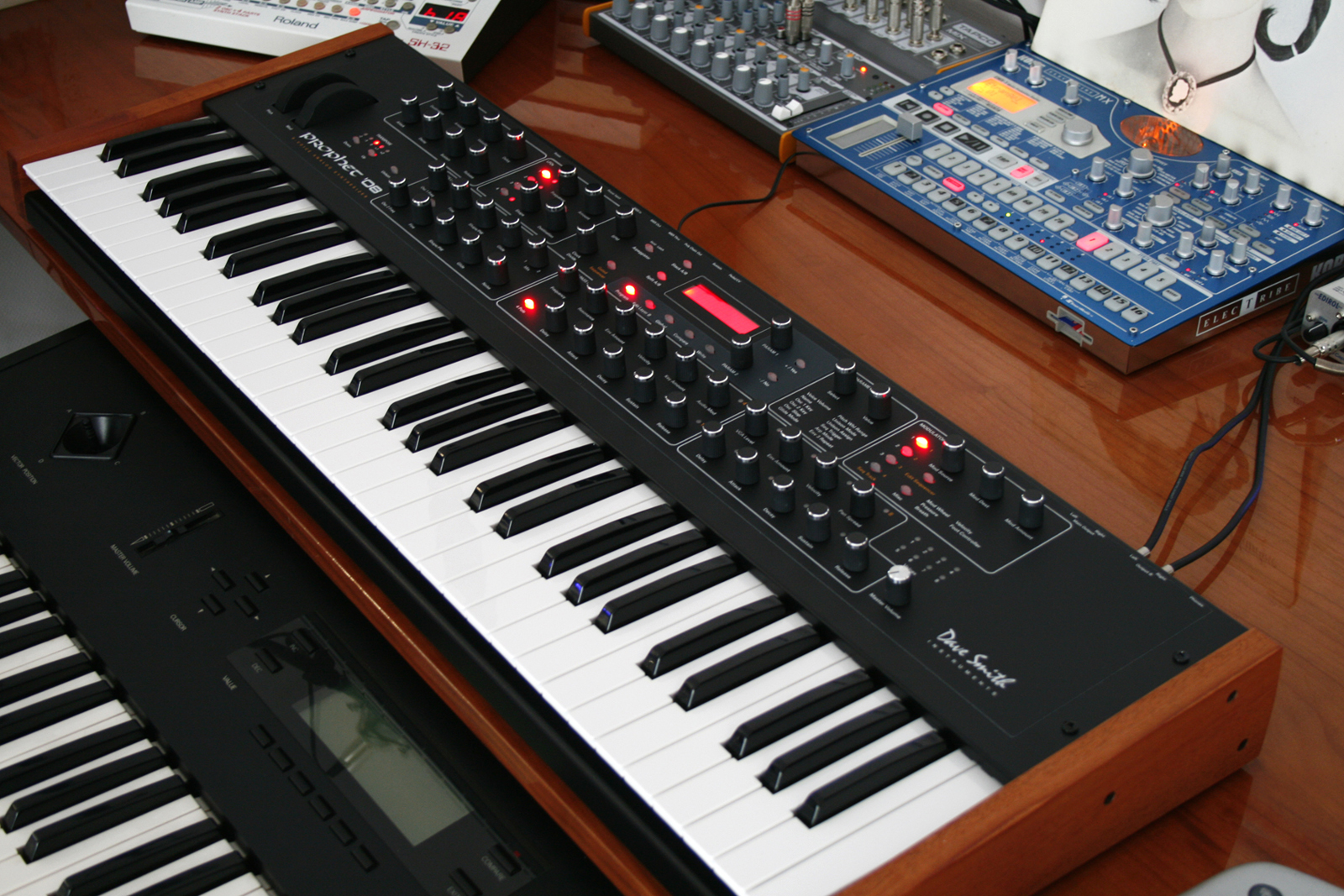
Unpacking : the instrument is well-built, lighter than most polysynths, especially analogue. It is unfortunate that the power supply be a wall wart, but other than that, it feels like a serious piece of gear. The interface is clean and well thought, with solid knobs – note here that they are very sensitive, and endless rotary, something I don’t care much for since it prevents you from acknowledging the parameters of a sound at sight.
The sound structure : what we’ve got here are 8 voices of good analogue signal, with a very sophisticated modulation system. More precisely, its analogue oscillators are digitally controlled, which ensures a very stable tuning while a special “slop” function takes care of the random drift we’re bound to expect. The result is most satisfying, and can be best described in good Trekkian fashion as “the best of both worlds” (and I promised myself I wouldn’t geek it up again…). You won’t get crazy over the oscillators going haywire at random, but at the same time the Prophet 08 sounds reasonably “sloppy”, as in “analogue sloppy”.
The Prophet 08 sound can be rich and smooth, even creamy, or – especially if you push the Audio Mod knob up – gritty and mean. The Prophet 08 makes excellent use of the stereo field too (you can “pan spread” the sound so that the voices are played alternatively on both sides, which can also be linked to the LFO), and the keyboard lets you control the sound with subtlety and character. Furthermore, each patch comprises two layers A and B, which can be stacked or splitfor deeper, more interesting sounds.
The sequencer : it is a gated sequencer, meaning that you have to press a key to play the sequence (or send a MIDI note), and it’s also a 16 steps sequencer : you have to program the sequence step by step, old school way… you can’t just record a pattern by playing the keyboard.
The sequencer, incidentally, is one reason why the Prophet 08 is a wonderful tool for creation. It allows you to juxtapose four different sequences on each layer (the Prophet 08 is able to layer two different patches, each one with their independent sequences running).
For instance, you can have the 1st sequence going to the oscillators (thus playing a melody), the 2nd sequence going to the filter cutoff (thus changing its value on certain notes), the 3rd sequence going to the filter resonance, the 4th sequence going to one of the four LFOs, etc, etc...
Multiply this by two if you're using the two layers and you got a pretty complex atmospheric track going on already.
To access the sequencer mode, press Edit sequencer, then assign the sequencer to a destination, using the Mod Dest knob. For basic melody programming, what you want to do is assign to OscAllFreq. By now, the 16 knobs that were controlling filter and envelope are reassigned to step programming. Turn each knob up to the note you want to program, and so on… If you want a step to be silent, turn the knob to the right until “Rest” shows on screen. If you want to use less than 16 steps, turn to “Reset” on the knob just after the number of steps you need (9th knob if you want an 8 step sequence).
Two Pads
One Pad
Prophet beat phased to death
Now, one important note : always remember that the Prophet 08 has two different layers, meaning two different sounds that you can stack up or play in split mode. Layer A and layer B are independent… when you press the Edit Layer B button, all knobs are reassigned to the B patch parameters. Whatever settings you use for layer B have no effect on layer A.
The same is true with the sequencer. You may program a melody on the layer A sequencer, and program a different melody on the layer B, or program a bass line on the A and a drum beat on the B… You can also program a sequence on one layer and no sequence on the other (for example, to produce a pad with a background melody).
Note also that the BPM and Clock Divide values for A and B are independent as well. If you change the tempo for the sequence in layer A, you have to change it as well in layer B, unless you’re after a polyrhythmic effect.
One last word : the sequence is part of the overall patch. You can’t program a sequence on a patch, then play it with a different patch, and to my knowledge, you can’t copy a sequence from a patch to another. The Prophet 08 is not a workstation! The gated sequencer wasn’t conceived to build complete songs, but to program grooves, complex and evolving pads, etc...
There’s a lot more that could be said, because the sequencer benefits from the extended modulation possibilities of the Prophet 08, but that’s the basic idea.
That said, the following sequences are singles patches, without effects or overdubbing.
prophetbeat1
Another minor bit of criticism, there’s an arpeggiator all right, and I’m always fond of that, but it doesn’t have a random mode. I don’t understand why, but I would qualify this as minor, because it can still be addressed in a further OS update. There’s also a primitive sequencer, useful to work out some grooves and complex sounds, but it’s a gated one, meaning that you have to press a note (or send one by MIDI to the synth) to make it work. Here again, I don’t quite understand the rationale behind that decision, but I guess I can live with it. More importantly, you can’t process external sound through the filter. That’s always a neat trick and it’s a shame the Prophet 08 is lacking it.
In summary : overall, the Prophet 08 is a great synthesizer, which should probably be preferred to most virtual analog synth in the same price bracket, especially if you go for the rack module. It’s not a workstation, and arguably it ain't the most complete polyphonic synth, but in a way, that's beside the point. The Prophet 08 is an instrument with its limitations, and there’s vast amounts of character and musicality here. It's complex enough to be versatile and thrilling to experiment with, but at the same time, elegant and straightforward, an instrument for musicians who don't care for fumbling through zillions of options and want something to play music with.
All Prophet 08 :
Place of Dead Roads
Bruce Springsteen's "The Promise"
Analogue, Numan-esque improvisation.
Apart from the big beat that comes in halfway through, everything was done with the Prophet 08, including the opening groove : Fading Fast
Single live take of a Prophet 08 patch, without external sequencer or effects : Prophet Jam
Patches :
Here's four simple Prophet 08 sounds I made : Prophet08.zip
To load them into your synth, use anything that transmit sysex - on Windows, I'd suggest Midi-Ox.
The B-xxx at the beginning of the sysex indicates where the sound is going to be put, so back up your own sounds first, because the corresponding patches will be replaced!
B1-15-StrangeWind.syx : It's a complex, ambient-rhythm pad. Use the mod wheel to change the tone.
As indicated in the file, it loads on 15, Bank 1, so back up your own sound in that slot beforehand if you don't want to lose it.
B1-25-Speedallish.syx : Electronic sequence, quite dynamic
B1-35-DoublePad.syx : An experiment with the Prophet's dual layering : a low pad morphes into a higher one
B1-36-4VoiceDreampad.syx : Another 4 voices analogue pad... use mod wheel to add some nice vibrato
Useful links
http://www.davesmithinstruments.com/products/p8/index.php
http://www.soundonsound.com/sos/feb08/articles/dsiprophet08.htm
http://www.keyboardmag.com/article/dave-smith-instruments/Dec-07/32707
http://remixmag.com/gear/reviews/remix_dave_smith_instruments_2/
http://www.musicplayers.com/reviews/keyboard/2008/0308_DSI_Prophet08.php
http://emusician.com/elecinstruments/dave_smith_prophet08/
http://web.mac.com/mwalthius/Site/Videos.html
http://prophet5.org/
Specifications (from DSI's site)
5-octave keyboard with semi-weighted action, velocity, and aftertouch. Spring-loaded pitch wheel and assignable mod wheel.
256 fully editable Programs (2 banks of 128) with 2 Layers (2 separate sounds) in each Program.16 x 4 gated step sequencer. Arpeggiator.
2 digitally controlled analog oscillators (DCOs) per voice with selectable sawtooth, triangle, saw/triangle mix, and pulse waves (with pulse-width modulation), and hard sync. White noise generator.
1 Analog Curtis low-pass filter per voice, selectable 2- and 4-pole operation (self-resonating in 4-pole mode). 3 Envelope Generators: filter, VCA, and assignable (four-stage ADSR + delay); Envelope 3 can loop. 4 LFOs. Glide (portamento): separate rates per oscillator. Analog VCAs.
Dimensions: 12.1" (30.73 cm) W x 34.8" (88.39 cm) L x 3.875" (9.84 cm) H (2.25" at front edge; the feet account for 0.25" of the total height). Weight: ~22 lbs. (9.98 kg). Ins and Outs.MIDI In, Out, Thru, and Poly Chain.Main stereo audio output: 1/4" unbalanced.Output B stereo audio output: 1/4" unbalanced.Sustain pedal input: accepts normally on or normally off momentary footswitch.Pedal/CV input: responds to expression pedals or control voltages ranging from 0 to 5 VDC (protected against higher or negative voltages).Headphone output: 1/4" stereo phone jack.
Thursday, November 5, 2009
Roland D50

I've been using the Roland D550 (rack version of the famous D50) for months, so it's high time I say a couple words about it.
The Roland D50 was a big success, featured prominently on a number of late 80’s hit songs, in a lot of ways, as symptomatic of the era than the Minimoog for the early 70’s.
There are two kinds of things you might want to do with a D50 : eighties-type pseudo-realistic sounds (strings, etc...) and weird atmospheric sounds and FX.
That doesn’t mean that the instrument cannot perform in synth leads or pads, but my personal feeling is that you’d be well advised to go for an analog or virtual analog synth instead. The best lead sounds on the D50 for instance rely quite a bit on its faculty to add acoustic characteristics to the sound. While it may not sound like a Prophet or a Moog, none of these fine analog machines can produce the intricate, evolving, ethereal digital sounds the D50 provides.
The Korg Wavestation comes close, but in an even more experimental, cold way, whereas the Roland D50 retains that odd, pseudo-realistic quality that gives its sounds a texture not to be found anywhere else in the market.
Strings for instance are outstanding. Not because they sound real, mind you. They sound like real strings the way a Mellotron sounds like real flutes. Hence the appeal. They have that special, imperfect tone that gives a mix a certain edge you don’t get with high-end sample-based instruments. Now you wouldn’t use a D50 in lieu of the Vienna Symphonic Library to do a serious soundtrack, but for a pop song, well, it works.
Ambient strings and FX
While 1987 musicians probably purchased it for pads or leads, these prove a bit dated to many 2009 musicians. But where the D50 unarguably still shines is sophisticated and complex soundscapes, the kind of weird, otherworldy sounds that set up a whole cinematographic atmosphere or add extra layers of sonic oddities to an otherwise regular pop song.
The D50 uses what Roland called Linear Arithmetic synthesis, and what we would now label as Sample+Synthesis. A full patch is made of 4 “partials”, that is, waveforms, assembled into 2 “tones”. The “partial” itself can either be sawtooth/square waveforms with pulse width or a PCM sample (out of a ROM bank of 100 samples).
The basic idea is that a good deal of what characterizes an acoustic sound is its attack. So, to save space while still giving a somewhat realistic feel to the sounds, Roland shortened the samples to the instrument’s attack, and looped some of them as well. The result is a mix of sampled attacks of natural instruments and classic synthetic waveforms that you can then alter with a fairly decent resonant filter and a comfortable array of modulation options.

Synthesis itself is your usual subtractive synthesis with low-pass filtering. Playing around with the partial and tone configurations, the keyboard split-points and the three LFOs along with their complex envelope generators is sure to make for most interesting, sophisticated soundscapes.
While the D50 isn’t a workstation, you’ll find integrated reverb and chorus. I strongly suggest that you switch these effects off altogether, even if the patch sounds less impressive at first. Just work out a good patch without effects, and add the external reverb of your choice. While the chorus is all right, the reverb has that nasty, metallic sound we have come to know and loathe from the early days of digital synths.
I had read somewhere that with the Juno-1 and its PG-300 expansion, Roland had made programming optional, but that’s a bit extreme – while the programming interface is sorely lacking, you can still, if you’re motivated, produce your own sounds. The statement rings a lot truer with the Roland D50. Interface-wise, here we stand in a desolate, 1980-style landscape with no hope of doing any serious programming without buying the optional PG-1000 programmer or using software. If you can program a sound from scratch on the Roland D50 alone, congratulations, you have the patience of a saint.
I myself prefer the hardware option, which gives you instant access to most parameters, and turns the Roland D50 into a fabulously expressive instrument. I have to admit, the PG-1000 is somewhat cluttered, and it’s sometimes hard to be sure what will happen when you push this or that slider, but on the other hand, it makes the whole thing quite unpredictable and exciting. At minima, the PG-1000 allows you to tweak factory patches to your liking in a more user-friendly way, but what makes the controller a great addition if you can afford it, is being able to fiddle with that über-digital synthesizer like you would on an old-fashioned analogue.
The Roland D50, like most digital synths of that era, can be found for less than 200€ (and count something like 120-150€ for the PG-1000). It’s all good for the musician who’s looking for a cheap but professional synthesizer that still have tons to offer in terms of experimentation.
There was a hint of nostalgia in my own research of a D50, that is, the simple pleasure of owning a great instrument that had me dreaming when I was a teen, and playing some of these classic late eighties patches.
The oh-so-famous Orinoco Flow sound
But obviously the D50 is a lot more than just an artifact of music technology, it’s a fine instrument with a character of its own and outstanding value-for-price ratio.
Tuesday, February 24, 2009
Roland Alpha Juno-1 and PG-300

First, a reminder... my new analogue pop free EP is out and if you haven't got it, well, you should because it's a good one, so browse that page down and come back!
The Alpha Juno-1 is a 1986 analogue polyphonic synthesizer from Roland.
It's also a very underestimated instrument.
The latter argument is irrelevant and probably uttered by persons who either have never actually played a Juno-1, or else have rotten burgers in lieu of ears. Since I can’t believe that there might be people on the internet with nothing better to do than bashing instruments they didn’t really play, I can only assume there is a rampant wave of burger infection affecting the synth-oriented population.
DCOs have received a considerable amount of scorn from analog purists all along the years. I don’t think they deserve it, because they made possible cheaper analog synths that regular musicans could actually buy, and reliable analog synths that regular musicians could actually bring on tour without having to fear night after night that the big fat analog chord that was supposed to bring the audience to their knees would come out as a pathetic yoink because of a nasty oscillator detune. Good DCOs don’t compromise sound quality as much as their detractors pretend. I actually read in a Juno-1 online review that since this Juno moved to DCOs, it sounded more digital than the VCO-based Juno-60. This, of course, is wrong, since all Junos are DCO-based. The reviewer could nonetheless tell the difference between the Juno-1’s DCOs and the Juno-60’s imaginary VCOs.

About the alleged coldness of the Juno-1, to be frank, these endless debates about “warmth” and “fatness” are somewhat tiresome to me, and trying to figure out by ear which Prophet revision sounds “warmer” is more likely to put me to sleep than a Lars Von Trier movie (I’m kidding, of course, I’ve seen “Dancer in the dark” and there’s no way you can fall asleep when assailed by such vapid nonsense).
Warmth, for one thing, is very subjective, and when discussing synths, it’s always useful to remember than our perception of analogue synthesizers as being “warm” relies on the way our ears are trained to grasp subtle nuances in audio quality. To most people, all synths pretty much sound “synth-ish”, and we all heard time and again music lovers averse to electronic instruments say that they were cold and lifeless, and I’m talking about the very same beloved analogue gear we know to be “warm” and “fat”.
But I digress… how’s that Juno-1 anyway?
The interface, let’s face it, is an abomination. All parameters, displayed on a tiny screen, are accessed by a combination of the big dial on the left, and the value button. This is, ha, I can’t even find the words to describe how unconvenient it is, so I’ll invent one, it is the one of the schprotziest synth interface I ever seen. There’s worse, but not many. Picture yourself programming a sound on the Juno-1. First you push “Parameter select”, then turn the dial clockwise to get to the parameter you want to modify, let’s say the chorus effect. Then push “Value”, then the dial again to change the value. Then “Parameter select” again, then the dial again to get to the next parameter, say the sub-osc level. Then “Value” again and the dial again to modify the value. And so on… That is tedious, dull, boring, well, total schprotz.
Juno tweaking
What you want to do for serious programming is get the PG-300 programmer along with the synth itself. The prices fly high and it’s not unusual to find the programmer at the same price than the synth. Now, I wouldn’t go as far as saying that Roland “made programming optional” (I’ve read that in an ebay bid some time ago). If you’re dedicated to creating your own sounds, I think you can cope with the schprotz, and there are some software editors to help you.

The combination of Juno-1 and PG-300 should probably be considered like the complete Alpha Juno synthesizer, and very often you’ll find both on sale as one package. The Juno-1 itself may be one of the cheapest analog synth on the market (I’ve got mine on ebay for 180€). Add the PG-300 and you jump to the prices of a reasonably priced Juno-106 or Juno-60, which begs the question : why would you buy an Alpha Juno instead of a Juno-60, for instance? 
Let’s begin to say that it does have that special 80’s analog Roland sound. Is it a Juno-60? Well, the answer is in the question. People who criticize the Alpha Juno for not sounding exactly like the Juno-60 must be the same kind who criticize the Prophet 08 for not being a Prophet 5. Just as the Prophet 08 is a Prophet, not the Prophet 5, the Alpha Juno is one kind of Juno, with a distinctive quality shared by all Junos, but in a darker, muddier flavour.
Whether it’s a good choice depends on the kind of sounds you’re after. It’s true that the Alpha Juno lacks the visual appeal of the other Junos. It is a rather bland, unremarkable black thing. It’s also true that it lacks an arpeggiator. But sound-wise, the difference is a matter of taste. The Juno-60 sounds more “educated”, while the Alpha Juno seems to drift closer to SH-101 territory. I love that actually. There’s a special gritty quality to the Alpha Juno that eludes the other Junos, and which I find very complementary to my smoother Prophet 08.
The Juno-1 works on a single oscillator with a choice of sawtooth and pulse, but also noise and 6 sub-oscillators. This is quite sparse, so a built-in chorus is added to fatten the sound a bit. Of course, it has been suggested that Roland needed on-board chorus in order to make the synth sound good. So what? There is no such thing as “cheating” in synthesizer design. The aim is to make a good-sounding instrument, right? How you achieve that aim is irrelevant. The chorus is intregral part of the audio chain that makes the Juno sound, and arguing that they wouldn’t sound as good without the chorus is like criticizing the Minimoog for not sounding as good without its third oscillator.
It's a good chorus, but you can choose to bypass it and put your own external effect unit. On the following example, the first part is played with the on-board chorus. The second and third are played with the on-board chorus off, and the Juno-1 passing through a Electro-Harmonix Small Clone pedal at two different settings.
Juno chorus

There’s a very useful chord memory function. Simultaneously press the chord memory and write button, then hit a chord. When you release the keys, the chord is memorized. Switch chord memory on, and each key triggers the whole chord. This is more than a fun gimmick, as it allows you to play chord blocks like you would play a mono line, with the voices being instantly reallocated to each new chord.
If instead of memorizing a chord, you memory a single note, what you get is a mono Juno…. But then try memorizing something like C1-C2-C3 and you’ve come across a nice way of creating complex mono leads.
Overall, the Juno-1 is a great instrument, with plenty of character, and in a way it’s thankfully underestimated, because that allows for a very affordable street price. I found it to be reliable, although my unit has a tendency to “forget” its first 8 user presets from time to time. The oscillators are of course very stable, but they remain analog… the Juno-1 may sometimes sound a bit odd in the first minutes, until it gets warmer. It is definitely a bargain polyphonic analog, that I would recommand any time against VSTs in the same low price bracket.


.jpg)