Monday, January 19, 2009

Small Stoned Prophet

The Small Stone is a revered phase shifter pedal from Electro Harmonix, with a most distinguished pedigree, harking back to the glory days of EMS, the groundbreaking british company responsible for such electronic marvels as the VCS3.

Engineer David Cockerell, first hired by EMS to work on early computer systems for music, designed in 1971 a very peculiar (and pricey according to long time user David Gilmour) guitar effect called the Synthi Hi-Fli, featuring advanced phase shifting and vibrato functions, along with that special EMS retro-futuristic look.


Engaged by Electro Harmonix, Cockerell went on to create some of the best guitar effects, including the Small Stone phaser. It is a very straightforward unit, with a rate knob and a colour switch, adding feedback to the 4 stage phasing effect. There has been a number of versions all through the years (some produced in Russia, the Sovtek series), sharing the same basic architecture, with slight differences in tone. Today’s commercial units are the fourth (classic) and fifth (nano) version.


While it is mainly a guitar effect, nothing prevents you from plugging another audio source, which is precisely what French synthesist JM Jarre did, using the first 1974 version of the pedal (seen above, photo from P.A.S.) on his Eminent 310U to create the astounding atmospheric pads of Oxygène (1976) and Equinoxe (1978).


My own Small Stone is the third version from 1980.
The following examples are done with the Prophet 08 only, processed by the Small Stone.

Two Pads

One Pad

The Prophet beat from the previous post, phased to death

Sunday, January 18, 2009

Snappy Enough for Ya?

In order to answer in sound a question that’s been asked on a Prophet forum, that is, how fast and tight can the Prophet 08 be, I made some beats using the on-board sequencer.

A word about the Prophet 08 sequencer, first...
It is a gated sequencer, meaning that you have to press a key to play the sequence (or send a MIDI note), and it’s also a 16 steps sequencer : you have to program the sequence step by step, old school way… you can’t just record a pattern by playing the keyboard.

To access the sequencer mode, press Edit sequencer, then assign the sequencer to a destination, using the Mod Dest knob. For basic melody programming, what you want to do is assign to OscAllFreq. By now, the 16 knobs that were controlling filter and envelope are reassigned to step programming. Turn each knob up to the note you want to program, and so on… If you want a step to be silent, turn the knob to the right until “Rest” shows on screen. If you want to use less than 16 steps, turn to “Reset” on the knob just after the number of steps you need (9th knob if you want an 8 step sequence).

Now, one important note : always remember that the Prophet 08 has two different layers, meaning two different sounds that you can stack up or play in split mode. Layer A and layer B are independent… when you press the Edit Layer B button, all knobs are reassigned to the B patch parameters. Whatever settings you use for layer B have no effect on layer A.

The same is true with the sequencer. You may program a melody on the layer A sequencer, and program a different melody on the layer B, or program a bass line on the A and a drum beat on the B… You can also program a sequence on one layer and no sequence on the other (for example, to produce a pad with a background melody).

Note also that the BPM and Clock Divide values for A and B are independent as well. If you change the tempo for the sequence in layer A, you have to change it as well in layer B, unless you’re after a polyrhythmic effect.

One last word : the sequence is part of the overall patch. You can’t program a sequence on a patch, then play it with a different patch, and to my knowledge, you can’t copy a sequence from a patch to another. The Prophet 08 is not a workstation! The gated sequencer wasn’t conceived to build complete songs, but to program grooves, complex and evolving pads, etc...

There’s a lot more that could be said, because the sequencer benefits from the extended modulation possibilities of the Prophet 08, but that’s the basic idea.
That said, the following sequences are singles patches, without effects or overdubbing.It sounds snappy enough to me!

Saturday, January 17, 2009

What is a Purist?

A purist is someone who’s preoccupied by the sonic difference between a Curtis chip and a SSM chip.
Things like that matter. They may not matter to you, and I mean you the casual and oh so ignorant listener, but they matter.

A purist is someone who thinks the recording of a Mellotron tape is different from the recording of the accurate sample of a Mellotron tape

A purist is someone who thinks synthesizers are used to make music for other purists, you know, the ones who believe they can tell if the song’s keyboard solo was played on a Curtis or a SSM-based synthesizer.

A purist is someone who thinks a Roland TB-303 is worth 1590€ (yes, I’ve seen that)
If you don’t know what a TB-303 is, let’s just say it is the worst bass synthesizer ever conceived. Yeah. I said it, punk.

A purist is someone who thinks digitally-controlled oscillators are for pussies

A purist is someone who thinks presets are for pussies

A purist is someone who thinks MIDI is for pussies

(The last three categories of purists are all pussies anyway, if they’ve gone past the Ondes Martenot technology… now, that was real music gear, man…)

A purist is someone who believes the first version of any synth is the best-sounding version ever. Of course, nothing beats the prototype.

A purist is someone who believes the Minimoog is the best synthesizer ever built.

A purist is someone who believes the Prophet 5 is the best synthesizer ever built.

A purist is someone who believes the Yamaha CS80 is the best synthesizer ever built.

A purist is someone who entertains the idea that one particular vintage instrument is the best synthesizer ever built.

I could go on and on.


I'm not a big fan of purists.

Thursday, January 15, 2009

Wavestation and Moog arpeggiator

An instrumental track using the Korg Wavestation for the main pads and the new Moog arpeggiator...

Wednesday, January 14, 2009

Pink Prophet (On the Run)


Some fun with the Prophet 08's step sequencer...
I didn't try to emulate the exact Pink Floyd track, but merely programmed the notes to make a little filter demo.

Monday, January 12, 2009

Some thoughts about gear addiction

The last couple of years, I’ve been investing quite some time (and money) into rethinking my personal studio. I’ve changed my main synths, from cheap virtual analog to rather pricey analog ones, I’ve changed my audio interface, bought some preamps, compressor and mixer, and only this year, got three different instruments. That behavior, surely, begs the question : am I suffering from gear addiction?

First point to address is : what do you need to make music? It’s always been my belief that you don’t need expensive instruments or gear to make music. A 3000€ guitar has never ever turned a mediocre musician into a good one, and the same is true with synthesizers. There are on this planet a number of people able to produce insanely bad music with outstanding electronic instruments. I can prove it. I’ve seen the Youtube videos. You have too.

That said, what a pricier, more sophisticated synth might grant you is more versatility and higher quality sounds. When you want to add Moog sounds to your music, and can afford to go hardware, the best choice is a Moog synthesizer… which comes at a price. But it remains that every synth, no matter how primitive, can be put to intelligent use and good music.

The second point is : how much is too much? What’s the limit between reasonable acquisition of valuable gear and compulsive buying of new junk?
Let’s say first that the good thing about hardware instruments is that they occupy space. Yes, yes… I know that software proponents argue about how the virtual aspect of soft synths marks their practical superiority. I actually believe in the exact opposite. The trouble with software instruments or effects is that they don’t take any place at all. That’s why whether you’re using illegal software or not, you always seem to wound up with 150 synthesizers and 300 different effects, barely using three or four on a regular basis.
Regarding hardware synths, well, you have to make choices. Up to my purchase of the Prophet 08, I would say that my choice of getting a new instrument or not depended on my musical needs. I wanted a strong, analog polyphonic synthesizer to serve as the basis of my sound.
Other instruments I’ve bought second-hand, like the Wavestation or the Juno, were more a question of having different sounds at my disposal. It’s not really that I needed them, but it’s handy to have different possibilities, sound-wise. A Juno doesn’t sound like a Prophet, and obviously the Wavestation is no Moog. So, depending on the sound I’m looking for in a particular song, I have possibilites.

Am I addicted? I don’t think so. I realise that from now on, every synth I’m buying, I don’t really need. But here’s the third point : it’s fun to buy new toys. For months now I’ve been looking for a Roland D50, or better, the D550 rack version. Why? Because that’s one instrument that made me drool when I was a teen. It was the kind of big, fancy, pro, oh-so-expensive synthesizer I was hearing on all these late 80’s records I loved, one I couldn’t dream of owning. Now with a little bit of luck you can find a D50 for 250€, which is ridiculous considering the power of the machine, and the original price tag. Do I need one? Hell, no. Would I just love to play these classic 80’s sounds of my childhood? Hell, yes.

Sunday, January 11, 2009

Moog Arpeggiator


Last friday I had my Little Phatty's memory upgraded, in order to install the 2.0 OS update .
The main feature is of course the new arpeggiator, which I found to be well-conceived and fun to play.

The patterns are up, down and order, that is, notes being arpeggiated in the same order they are played. Sadly, no random mode... but I believe that could come in a future update.
The arpeggio can then be played in a loop (for a Cm chord : C - Eb - G - C - Eb - G, etc...), back and forth (C - Eb - G - Eb - C - Eb - G, etc...), or one-shot (C - Eb - G, then stops).
I've always been fond of arpeggiators. They aren't for people too lazy to program sequencers, like I've heard sometimes. It's a tool to play with, and interact with.
Some snippets I did today while testing it.


They are quite simple sounding, using merely a single oscillator, because as I've started, I realised that the Little Phatty was badly out of tune, and the calibration routine takes quite some time, so...
I'll upload more interesting songs using the Moog arpeggiator along with beats and other instruments.

Saturday, January 10, 2009

Prophet 08 Patches (well, four of them)

Haven't been very active this week for work and health reasons (damn winter!)...
So, let's start a patch series!
I love patches and it's surprinsingly hard to find some on the web.
Here's four simple Prophet 08 sounds I made :
Prophet08.zip
To load them into your synth, use anything that transmit sysex - on Windows, I'd suggest
Midi-Ox
The B-xxx at the beginning of the sysex indicates where the sound is going to be put, so back up your own sounds first, because the corresponding patches will be replaced!

Saturday, January 3, 2009

Yamaha SY35

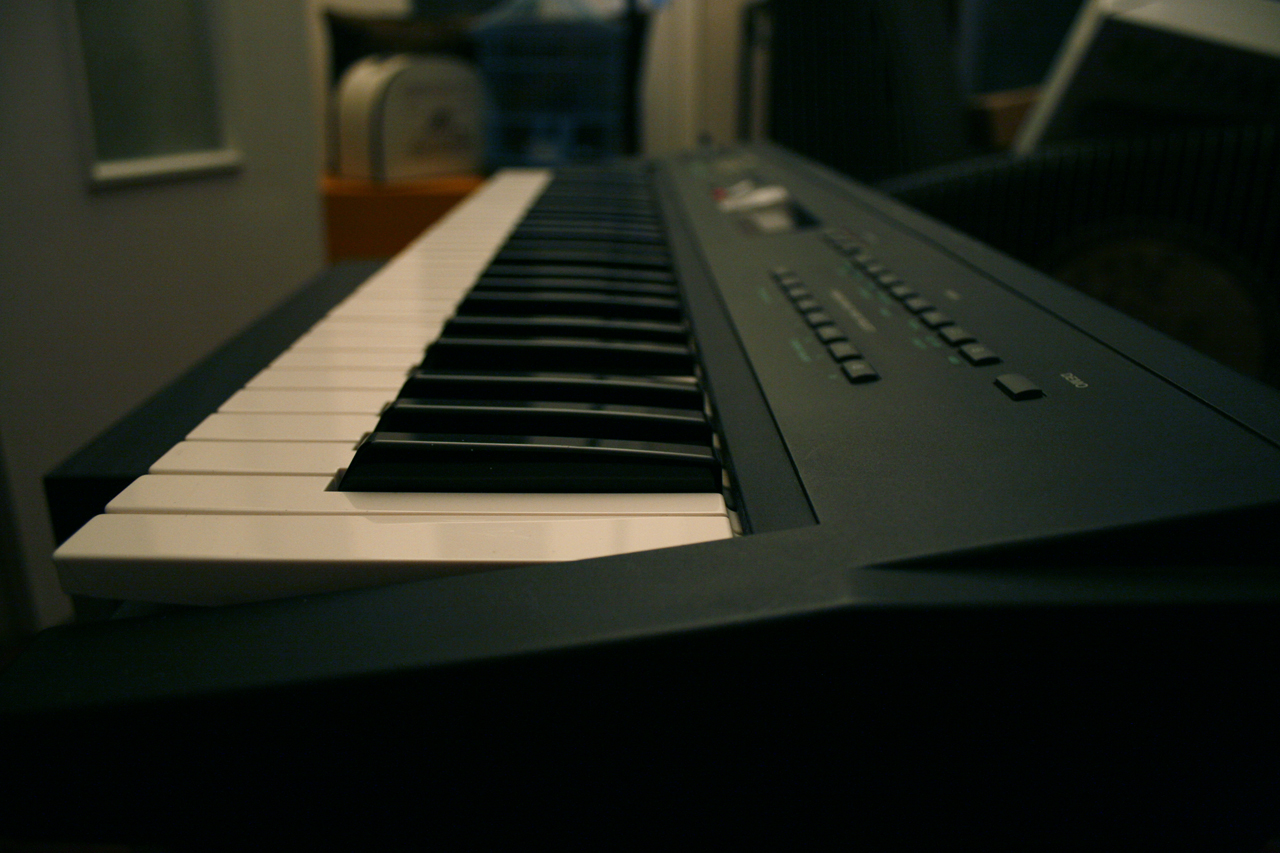
This is a farewell review! I’ve just sold, with a fair measure of nostalgia, my good old SY35. I owned it for fifteen years but now is the time when there just isn’t room enough for all the instruments…
(As usual, the pics link to hi-res versions of the photographs)


The SY35 is a budget synth, with enough power to provide for very interesting sound design. It wasn’t very expensive at the time, and it’s laughably cheap these days. The construction is good. It may come in a plastic case but I’ve never encountered a single bug, all the buttons still function properly and the 61 keys keyboard works quite good after being used as master keyboard for all these years.


Of course, there’s the interface issue… the SY35 is the reason why I’m tolerant of the shortcomings, interface-wise, of most synths. Some may have a lousy interface, but the SY35 is the less practical instrument to program I’ve ever played.


The SY35 is sixteen voices polyphonic and multimbral (eight parts). There are 128 sounds. 64 are factory presets that you can’t erase, mostly acoustic (most notably, some good electric pianos, excellent vintage strings and a lovely choir patch). The other 64 are user presets, for storing your own creations.


Sounds are built around no less than four oscillators, two FM and two AWM (that is, basically acoustic samples). Each FM oscillator has its dedicated tone control, which is Yamaha's way to allow for low-pass-filter-ish effect on the timbre. Real filters are implemented on the SY55 and upwards. Add four LFOs and sixteen (decent but not great) effects, and that’s pretty much it.


What brings this rather straightforward architecture to life is probably the vector synthesis joystick, which allows you to move the focus between the four basic elements. That, and the possibility of mixing purely electronical tones with good quality samples, provides for sophisticated sounds. You may even record a particular joystick movement and loop it. What at first could look like a gimmick is actually an asset of the SY35, even more so considering the rarity of vector synthesis.


How does it sound? Be warned, this is a truly, unashamedly digital instrument. It can sound cold, industrial and harsh, and given good programming it can also sound mellow, rich and lush. The SY35 excels at dense, complex sound design, and is a good addition to any experimental setup.


Here's a little improvisation I did yesterday while I still had my beloved SY35.
Everything is SY35 except drums.


Friday, January 2, 2009

Zelda is Back (in Prophet form)


Another Prophet 08 demo using a midi file, this time, the sanctuary music from Zelda 3...
Aaah, those great Prophet pads...